
Some people seem to pack on muscle effortlessly, while others grind through months of training with modest results. The answer, it turns out, is written – at least in part – in your genes.
The biology behind building muscle
Every time you lift a weight, you are damaging your muscle fibres at a microscopic level. The body detects that damage, mounts a repair response, and rebuilds those fibres slightly thicker and stronger than before. Over weeks and months, those incremental repairs add up to visible muscle growth, a process scientists call skeletal muscle hypertrophy.
At the centre of this process are satellite cells, which activate under mechanical stress, fuse with damaged fibres, and boost their capacity to produce structural proteins. Those proteins, primarily myosin and actin, are assembled through molecular pathways triggered by hormones such as testosterone and IGF-1. The balance between protein synthesis and breakdown determines whether muscle grows or shrinks. Training tips the scales one way; poor nutrition and recovery tip them the other.
Muscle fibre type adds another variable. Slow-twitch (TypeI) fibres are built for endurance; fast-twitch (Type II) fibres generate more force and have greater potential for hypertrophy. Most people have a roughly equal mix, but that ratio varies among individuals, and genetics can predispose someone to different fibre type leanings before they ever set foot in a gym.
Where your DNA comes in
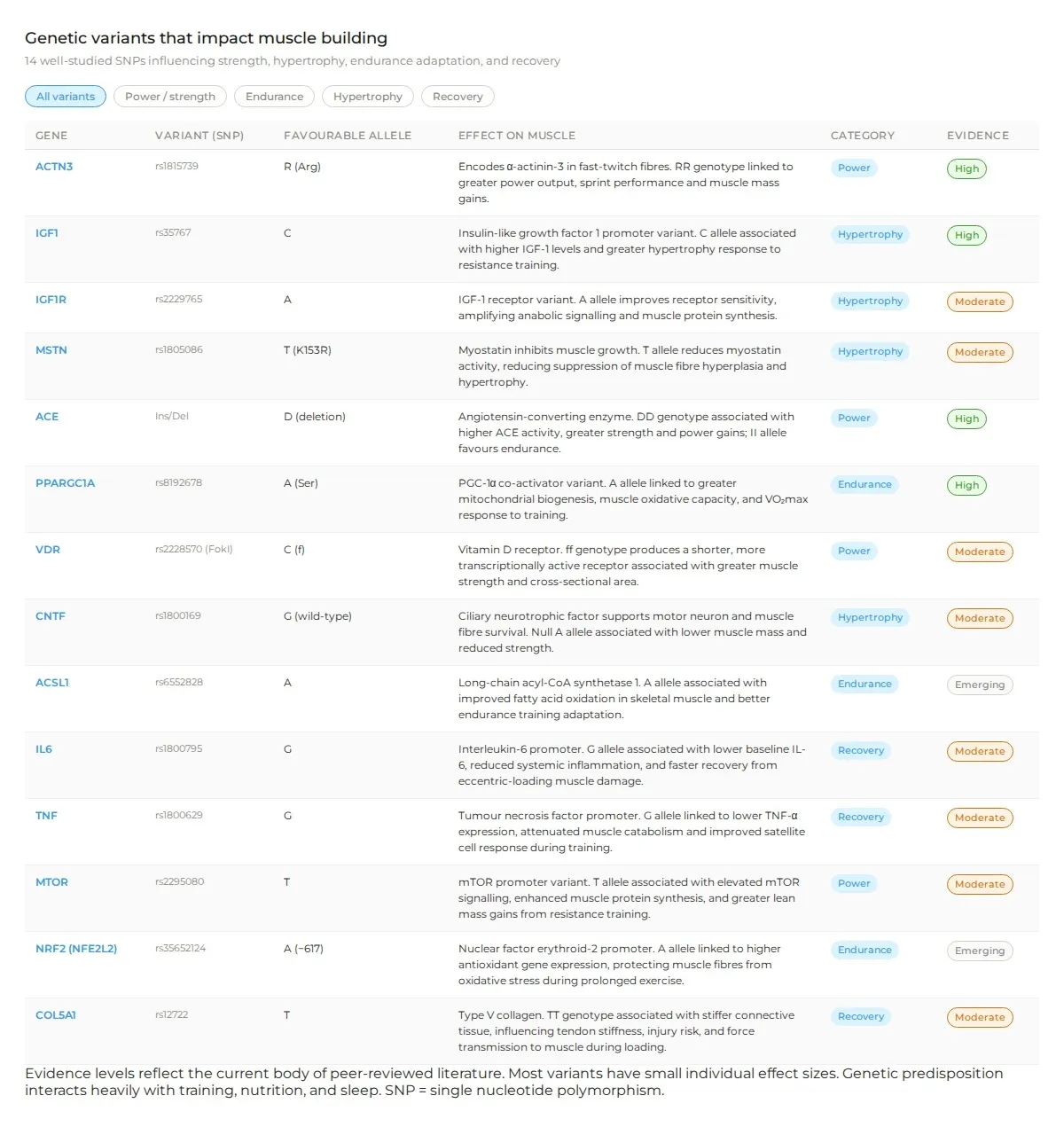
The mechanics of muscle building are universal. The rate at which they unfold is not. Your genome does not decide whether you can build muscle – it determines how quickly and easily you do so. Research has identified dozens of genetic variants, known as SNPs, that influence individual response to resistance training.
One of the most studied is ACTN3, which encodes a structural protein found almost exclusively in fast-twitch fibres. A common variant produces a non-functional version; roughly 18% of the global population carries two copies, producing none at all. Those with the functional version tend toward greater power output and strength response, while those without it often show a more endurance-oriented physiology. Neither is superior, but they are meaningfully different starting points.
The IGF1 and IGF1R genes govern production of and sensitivity to insulin-like growth factor 1, a primary hormonal driver of muscle protein synthesis. Variants associated with higher IGF-1 levels or greater receptor sensitivity correlate with larger muscle mass and stronger hypertrophic response. Meanwhile, MSTN, which encodes myostatin, the body's natural brake on muscle growth, influences the upper ceiling of that response. Variants that reduce myostatin activity are associated with greater gains from training.
A 2019 study in the Journal of Applied Physiology found that roughly 45% of variance in hypertrophy response to a standardised programme was attributable to genetics. The remaining 55% came down to training, nutrition, sleep, and lifestyle - a reminder that genes set tendencies, not destinies.
"There is no single 'muscle gene.' Dozens of variants collectively shape a person's ceiling, their floor, and how quickly they move between them."
What does this mean for you?
Genetic variation in muscle-building capacity is a spectrum, not a binary. Most people cluster around the middle, with a minority at either end. Wherever you fall, progressive resistance training and adequate protein will produce results - the question is how dramatic and how fast.
Consumer genetic testing can now assess variants such asACTN3, IGF1, and MSTN, but the predictive value of single-gene results remains limited. The interactions between variants, and between genes and environment, are too complex to reduce to a handful of SNPs. A test flagging an"endurance profile" based on ACTN3 alone says nothing about your training age, recovery quality, or the dozens of other variants simultaneously at work.
Some providers are tackling this more rigorously.FitnessGenes moves beyond single-SNP analysis by calculating polygenic scores, composite measures that aggregate many variants simultaneously, weighted by their known effect sizes. This better reflects biological reality: no single gene controls muscle-building speed, but the combined signal of many variants can meaningfully differentiate individuals in ways single-marker testing cannot.
Where genetic insight has genuine value is in calibrating expectations. Modest gains after months of consistent training may not reflect poor technique or lack of effort - they may simply reflect where you sit on the genetic distribution. That knowledge redirects energy toward what you can control: training volume, progressive overload, protein intake, sleep, and above all, consistency over the years.
FAQs
1. I have a less favourable genetic profile for muscle building. Does this mean I can't build muscle?
No. A less favourable profile shifts the rate and ceiling of muscle growth - it doesn't prevent it. Genetics accounts for roughly 45% of hypertrophy variance, and the body's adaptive response to resistance training is universal - mechanical stress, fibre repair, and protein synthesis occur regardless of your starting genotype. Where genetics plays out is in how sensitively those adaptation pathways respond: you may need greater training stimulus to trigger the same signal, but the signal still fires.
2. I have a favourable genetic profile for muscle building.Is this always an advantage?
Largely yes, but with some nuance worth understanding. A favourable profile - typically characterised by functional ACTN3 expression, reduced myostatin activity, higher IGF-1 signalling, and a greater proportion of fast-twitch fibres - creates a more responsive physiological environment for hypertrophy. Gains tend to come faster, recovery tends to be quicker, and the ceiling for muscle mass tends to be higher.
The caveats are real, however:
- Reduced myostatin activity accelerates hypertrophy but may also increase tendon and connective tissue loading, raising injury risk if training volume is escalated too quickly.
- Chronically elevated IGF-1 above the normal physiological range - particularly when artificially induced - has been linked epidemiologically to increased risk of certain hormone-sensitive cancers. This is not a concern at natually occuring levels, but it is a reason why attempting to pharmocologically amplify an already high signal carries trade-offs.
- Genetically gifted responders can mask poor programming. Fast gains in the early years can make it harder to identify whether training and nutrition are actually optimised, since results arrive regardless.
A favourable profile is an advantage, not a guarantee of optimal outcomes.
3. What foods support the genetics of muscle building?
Genetics sets the sensitivity of the pathways; nutrition determines how well those pathways are fuelled. The most impactful dietary factors across the key muscle-building genes are:
Protein quantity and quality:
- Total protein intake of 1.6–2.2g per kg of bodyweight per day is the single most important dietary variable for hypertrophy, regardless of genetic profile
- Animal proteins (meat, fish, eggs, dairy) provide a complete amino acid profile, including leucine, the primary trigger for mTOR-mediated protein synthesis
- Dairy specifically amplifies IGF-1 signalling beyond what its protein content alone would predict, due to naturally occurring growth factors
Micronutrients that support key pathways:
- Zinc and magnesium - required for testosterone synthesis and IGF-1 receptor function; found in red meat, shellfish, nuts, seeds, and wholegrain
- Vitamin D - supports IGF-1 receptor sensitivity and muscle fibre function; found in oily fish, egg yolks, and fortified foods, though sunlight exposure is the primary source for most people
- Creatine from red meat - dietary creatine supports the same phosphocreatine system that creatine supplementation targets, amplifying training intensity and the downstream anabolic signal
Caloric balance
- A modest caloric surplus (200–400 kcal above maintenance) provides the energy substrate for muscle protein synthesis; chronic restriction suppresses IGF-1 and blunts hypertrophy even when training is consistent
4. What supplements interact with muscle-building genetics?
The supplement market significantly overstates what most compounds do. The list of products with genuine, replicated evidence is short.Here is how the credible options map onto the genetic pathways discussed inthis article:
Well-supported:
- Creatine monohydrate - the most robustly evidenced supplement for hypertrophy; amplifies the local IGF-1 response within muscle post-training, supports mTOR signalling, and increases training capacity across multiple sessions
- Whey protein - the leucine-rich amino acid profile acutely stimulates IGF-1-mediated protein synthesis more effectively than slower protein sources; most useful when total dietary protein is hard to hit through food alone
- Vitamin D3 (with K2) - restores IGF-1 receptor sensitivity and supports the broader hormonal environment in individuals who are deficient; widespread deficiency makes this broadly relevant
Beneficial in deficiency, limited otherwise
- Zinc and magnesium - support IGF-1 signalling and testosterone production when intake is low; little measurable benefit in individuals who are already replete
- Omega-3 fatty acids - reduce systemic inflammation (relevant to IL-6 and TNF variants linked to recovery), and have modest evidence for improving muscle protein synthesis rates in older adults