
The science of genetic training response - and how to use it to your advantage.
Same programme. Same effort. Wildly different outcomes.
If you've ever followed a training plan to the letter and wondered why your results didn't match someone else's, the answer is rarely effort or discipline. It's biology. Specifically, it's how your genome shapes your response to training stimuli – which adaptations you make quickly, which take longer, and which require a fundamentally different approach to unlock.
This isn't about genetic determinism. It's about precision. Understanding your training response profile means less guesswork, fewer wasted training blocks, and a more direct path to the adaptations you're after.
The High Responder / Low Responder Problem
Data from the HERITAGE Family Study - one of the most comprehensive investigations into exercise genetics - show that roughly 50% of the variation in VO₂ max trainability between individuals is genetic. The population doesn't split neatly into two camps, but the extremes are striking: some individuals improve VO₂ max by over 40% on a standardised programme. Others improve by less than 5% on the same protocol.
That gap is not explained by compliance, fitness history, or effort. It's largely genomic.
What genetic variants can influence VO₂ max trainability?
Three variants with particularly strong evidence for VO₂ max trainability:
- ACSL1 (rs6552828) - governs long-chain fatty acid activation; influences aerobic substrate efficiency
- AMPD1 (rs17602729) - regulates AMP deaminase activity and purine nucleotide cycling under high-intensity load
- ACE (rs4343) - modulates the renin-angiotensin system and cardiovascular oxygen delivery
The practical implication is clear: if you're a low responder to interval-based training, continuing to stack high-intensity sessions won't close the gap. Higher-volume, lower-intensity aerobic work – or an entirely different periodisation structure – may drive substantially better adaptation. Genetics tells you which lever to pull.
Lactate Threshold: Where Genetic Variance Is Most Dramatic
Perhaps the most striking example of genetically mediated training response comes from lactate threshold data.
Variants in PPARD (rs2267668) and PPARGC1A (rs8192678) - encoding peroxisome proliferator-activated receptor delta and PGC-1α, respectively - have been shown to dramatically modulate anaerobic threshold adaptation. In the Tübingen Lifestyle Intervention Program, individuals carrying no beneficial alleles improved their lactate threshold by approximately 11%. Those with the most favourable variant combinations improved by up to 120%.
Same training stimulus. An order of magnitude difference in outcome.
How can the PPARGC1A gene affect lactate threshold?
PGC-1α is a master regulator of mitochondrial biogenesis - the process by which your cells build new mitochondria in response to aerobic training. Higher PGC-1α activity means more mitochondria, better oxidative capacity, and a faster-shifting lactate threshold. Individuals with lower-activity variants aren't non-responders - they simply need a different training dose, typically higher volume at lower intensities, to achieve comparable mitochondrial upregulation.
VO₂ Max vs. HRV: Not All Markers Respond the Same Way
An important nuance: genetic influence on training response is not uniform across all performance markers.
VO₂ max trainability, as discussed, is substantially heritable. Heart rate variability (HRV) - a widely used marker of aerobic fitness and autonomic recovery - tells a different story. Analysis of nine relevant gene variants accounts for only 1–2% of variance in HRV and resting heart rate. The genetic contribution here is modest; age, sex, training load, and sleep quality are far more influential.
What this means practically: if your HRV isn't responding as expected, look first at recovery, sleep, and training load management before attributing it to genetics. Conversely, if your VO₂ max response to a training block feels disproportionately low, genetics is a more likely explanatory variable - and worth investigating.
Carrying more risk variants at HRV-associated loci is associated with a ~0.3-0.5 ms lower RMSSD at baseline. This modest suppression may slightly blunt responses to intensive training, suggesting a more conservative approach to acute training loads for these individuals.
Muscle Fibre Composition: The Training Response Foundation
Training response doesn't operate independently of underlying muscle architecture. ACTN3 (R577X) is one of the most studied variants in sports genomics, encoding α-actinin-3 - a structural protein expressed exclusively in fast-twitch muscle fibres.
- R/R genotype: full α-actinin-3 expression; fast-twitch fibre dominance; superior power and sprint adaptation
- X/X genotype: absent α-actinin-3; shift toward oxidative metabolism; greater endurance efficiency and fatigue resistance
This isn't simply about event selection. It shapes how you should structure training stimulus across a programme.
How does your ACTN3 variant influence training response?
R/R individuals typically respond better to neuromuscular and high-intensity work to preserve fast-twitch function; X/X individuals often show superior adaptation to sustained aerobic volume. Mixed R/X genotypes sit between these profiles and generally tolerate a wider range of training approaches.
Can training change how my genes behave?
Your DNA sequence is fixed. How your genes are expressed is not, and this is where training becomes genuinely transformative at a molecular level.
Long-term endurance training induces durable epigenetic modifications - changes to DNA methylation and histone acetylation states - that shift gene expression toward a pro-endurance, pro-recovery profile. Key pathways activated by sustained aerobic training include:
- PGC-1α / NRF1 / TFAM axis - sustained upregulation of mitochondrial biogenesis beyond individual sessions
- AMPK - the cellular energy sensor; activates fat oxidation and mitochondrial adaptation under metabolic stress
- SIRT1 - histone deacetylase that promotes stress-resistance gene expression and metabolic flexibility
Critically, skeletal muscle develops an epigenetic memory of training. The chromatin remodelling that follows repeated aerobic bouts keeps beneficial genes in a more transcriptionally accessible state - meaning the longer your training history, the more efficiently your body re-adapts after any period of reduced load.
This has a direct implication for programme design: training consistency compounds. The epigenetic architecture built over months and years creates a biological substrate that amplifies the response to future training stimuli. Interrupted, inconsistent training forfeits this advantage.
Genetics shows what to do, and epigenetics reinforces your effort.
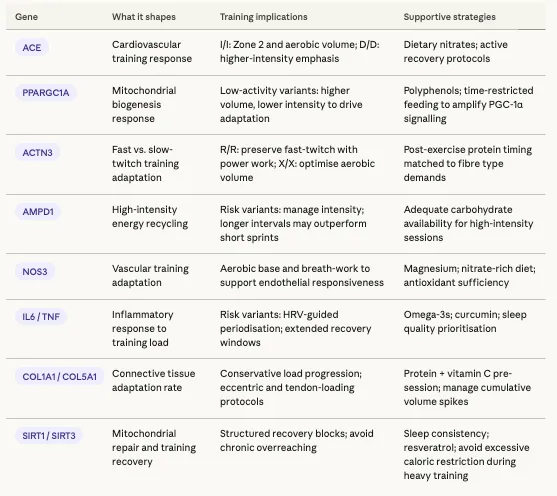
Translating Genotype Into Programme Design (examples)
The Bottom Line
Training response is not uniform - and the variation isn't random. It's encoded in your genome, modulated by your hormonal environment, and further shaped by the epigenetic history your training builds over time.
The athletes who adapt most efficiently aren't necessarily the ones working hardest. They're the ones whose programme is aligned with how their biology actually responds to stimulus.
That alignment starts with knowing your genetic profile.
At FitnessGenes, we integrate genomic data with training and lifestyle markers to build programmes calibrated to how you specifically respond - not how the average athlete does. Because in performance, average recommendations produce average results.
Key References
HERITAGE Family Study (PMC3098655) · Tübingen Lifestyle Intervention Program (PMID 17327385) · Nature Communications HRV GWAS (ncomms15805) · ACTN3 and muscle phenotype (PMID 18043762) · CYP19A1 oestrogen metabolism (PMC4303212) · Exercise iron demands (PMID 38068803)