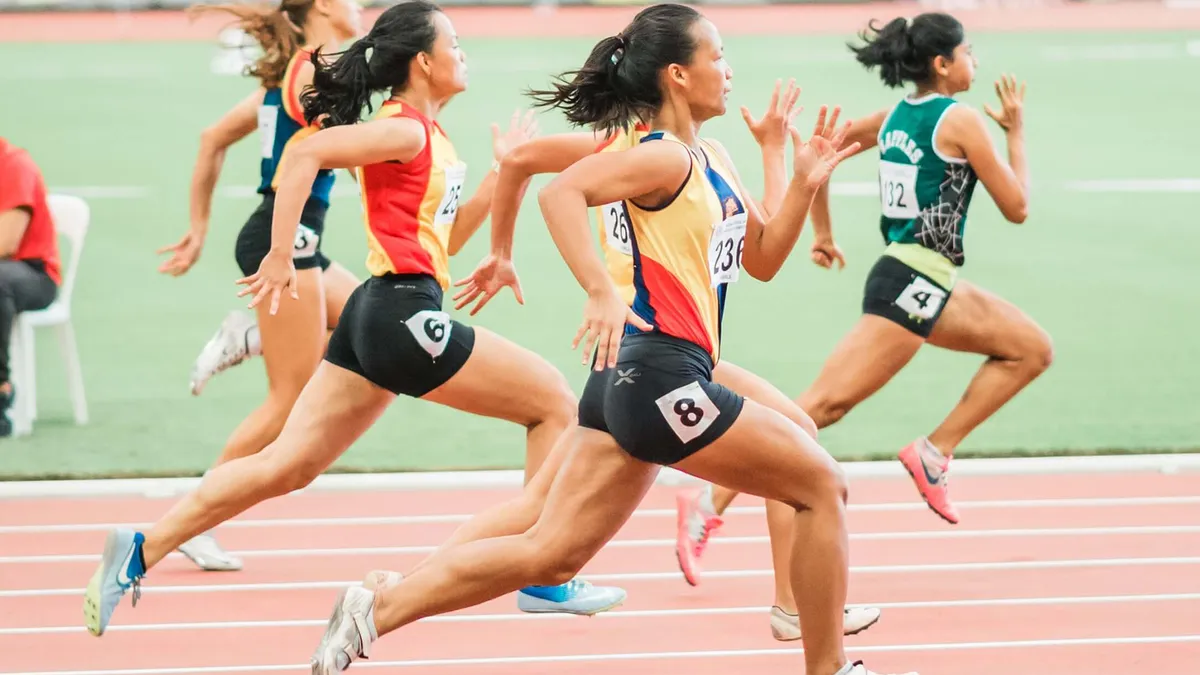
ACTN3 - the famous “gene for speed” - codes for the alpha-actinin-3 protein. This protein supports high-velocity, forceful muscle contractions in Type II (or fast) muscle fibres. This action of alpha-actinin-3 is what has brought so much interest around the gene ACTN3 and what influence it may have on determining if you are better suited to power or endurance activities.
The ACTN3 gene affects whether or not you produce alpha-actinin-3. The R variant results in production of this protein and is associated with greater strength, speed and power performance. On the other hand, the X variant leads to no alpha-actinin-3 being produced which may provide a disadvantage when it comes to strength, speed and power performance, particularly at elite standards.
So, should you give up on your sprinting if you haven’t got the R variant? Ultimately, while your ACTN3 genotype offers a useful lens into your natural muscle fibre tendencies, it represents just one piece of a much larger genetic and environmental puzzle, and should inform, rather than dictate, how you train.
What is ACTN3 and what does it do?
The ACTN3 gene sits on chromosome 11 and provides the instructions for building alpha-actinin-3, a structural protein found exclusively in the fast-twitch muscle fibres responsible for explosive, high-velocity movements. It is one of the most extensively studied genes in sports and exercise science, and has been dubbed the 'gene for speed' owing to its consistent association with power and sprint performance across multiple research cohorts. Variants of ACTN3 are remarkably common - around 18% of people of European descent carry the genotype that results in no alpha-actinin-3 production whatsoever - making it one of the few gene variants where a complete loss of protein function is both widespread and compatible with normal health.
The ACTN3 gene has a well-studied single nucleotide polymorphism, or SNP, where a single letter change in the DNA sequence - from C (Cytosine) to T (Thymine) - has a significant downstream effect. This substitution converts a normal codon (CGA), which instructs the cell to add the amino acid arginine, into a stop codon (TGA), signalling the cell to halt protein production prematurely. The result is that no functional alpha-actinin-3 is made.
This gives rise to two allele variants: the R allele (carrying the original C), which produces alpha-actinin-3 normally, and the X allele (carrying the T substitution), which produces none. Because we inherit one copy of each gene from each parent, these two variants combine to create three possible genotypes: RR, RX, and XX.
What do the three genotypes mean?
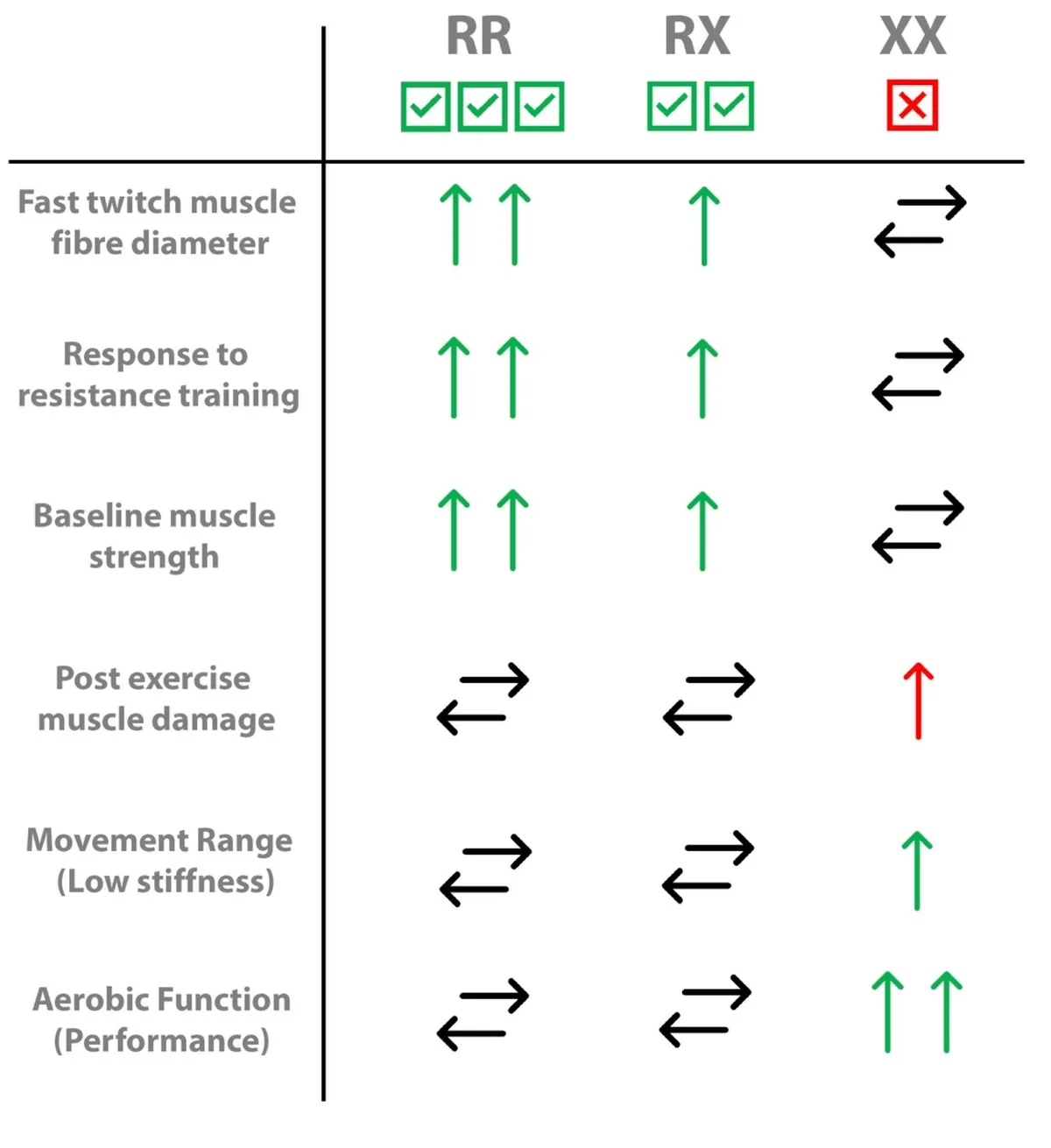
The three possible genotypes: RR, RX, and XX can be summarised below:
- RR – people with this genotype have two copies of the R allele and therefore produce the alpha-actinin-3 protein. As they have two copies of the R allele, such individuals’ muscle fibers produce high levels of alpha-actinin-3.
- RX – people with this genotype have one copy of the R allele and therefore produce the alpha-actinin-3 protein. As they have only one copy of the R allele, people who are RX produce less alpha-actinin-3 compared to those who are RR.
- XX - people with this genotype have two copies of the X allele and therefore do not produce any alpha-actinin-3 protein. Individuals with the XX genotype are said to have alpha-actinin-3 deficiency.
How do the different genotypes affect athletic performance?
The R allele and power/sprint performance
The R allele is consistently associated with strength, sprint and power sports requiring explosive muscle contractions. A large review of over 20,000 subjects confirmed a significant link between the R allele and elite power athlete status, and a study of Olympic power athletes found none carried the XX genotype, suggesting it may be incompatible with performance at the very highest level. This was consolidated by a 2024 meta-analysis that found that the RR genotype and R allele were overrepresented in power athletes compared to both non-athletes and endurance athletes,
Beyond elite sport, research on non-athletes shows that RR and RX individuals tend to have greater muscle size, higher baseline strength, larger strength gains in response to resistance training, faster sprint times, and a higher proportion of Type II (fast-twitch) muscle fibres - particularly Type IIx fibres, which contract rapidly and rely on anaerobic energy. Whether the RR genotype confers a meaningful additional advantage over RX remains unclear, with studies reporting mixed findings.
The XX genotype and endurance performance
The trade-off for lacking alpha-actinin-3 may be a modest advantage in endurance activities. Some studies have found XX individuals overrepresented among elite endurance athletes - one study of elite Israeli endurance athletes found 34% carried the XX genotype versus 18% of controls, and world-class endurance athletes in a separate study were 3.7 times more likely to be XX than national-level competitors. However, this relationship is considerably less robust than the link between the R allele and power performance, with studies of Russian endurance athletes and Ironman triathletes producing conflicting or null results.
The table below outlines the key performance differences between the three genotypes:
Does the XX genotype mean I can't be powerful or build muscle?
If you are concerned that your genotype puts you at a disadvantage for sprint or power activities, it is important to understand that muscle fiber composition is relatively "plastic." This means your body adapts and changes based on the stimulus you provide it. In one notable study, subjects who completed just six weeks of high-intensity sprint training saw a 7% decrease in slow-twitch (Type I) fibers and a significant 12% increase in fast-twitch (Type IIa) fibers.
How much does ACTN3 actually matter in practice?
While your DNA provides the blueprint, environmental factors like your training intensity, nutrition, and lifestyle habits are the primary drivers of your actual physical performance. Research indicates that approximately 40% of the variation in your muscle fiber proportions is determined by environmental factors, such as how specifically you train, rather than just the genes you were born with.
Single gene variants, such as ACTN3, exert a relatively small influence when analyzed in isolation. For context, a study of elite 200m sprinters found that the ACTN3 genotype explained only 0.92% of the variance in their sprint times. While that fraction of a percent might determine a podium finish at the Olympic level, for the non-elite athlete, the volume and quality of your training are exponentially more impactful than a single genetic marker.
How should I train based on my ACTN3 genotype?
Although the impact of your ACTN3 gene variant may only have a small effect, it can still inform and guide you on determining the most effective ways to train, either by targeting potential weaknesses or optimising biological strengths.
If you have the RR genotype, you would typically respond better to neuromuscular and high-intensity work to preserve fast-twitch function. An example of this would be using lower rep ranges and higher loads in your resistance training. If you have the XX genotype, you may experience superior adaptation to sustained aerobic volume. Using resistance training as an example again, using higher reps may be more beneficial. If you have the RX genotype, you sit between these profiles and generally tolerate a wider range of training approaches.
Does ACTN3 affect muscle recovery and soreness?
Studies suggest that individuals with the XX genotype of ACTN3 may experience greater muscle damage during exercise, and therefore longer recovery times between workouts. This is particularly evident in studies that have looked at the effect of eccentric contractions (where a muscle lengthens under tension, such as the downward motion of a bicep curl). People with the XX genotype were more likely to have higher levels of creatine kinase in their bloodstream following exercise. Creatine kinase is a marker of muscle damage.
The potential mechanism behind the increased muscle damage could be down to the absence of alpha-actinin-3 in those with the XX genotype. Without alpha-actinin-3, the Z-disks (the borders between the individual contractile units of muscle fibers) are composed primarily of alpha-actinin-2 which can make the fibers less stable and more susceptible to mechanical stress caused during training.
In summary, if you carry the XX genotype, your muscle fibers may be more susceptible to structural damage during taxing workouts, leading to higher markers of soreness and a requirement for more significant recovery time between sessions.
Are there supplements that can benefit me if I’m XX?
Creatine has consistently been shown to benefit strength and power production, so adding this supplement into your regime would be advantageous. Combining creatine with a carbohydrate source post-exercise has also been shown to enhance muscle glycogen store replenishment, which in turn can benefit recovery after exercise.
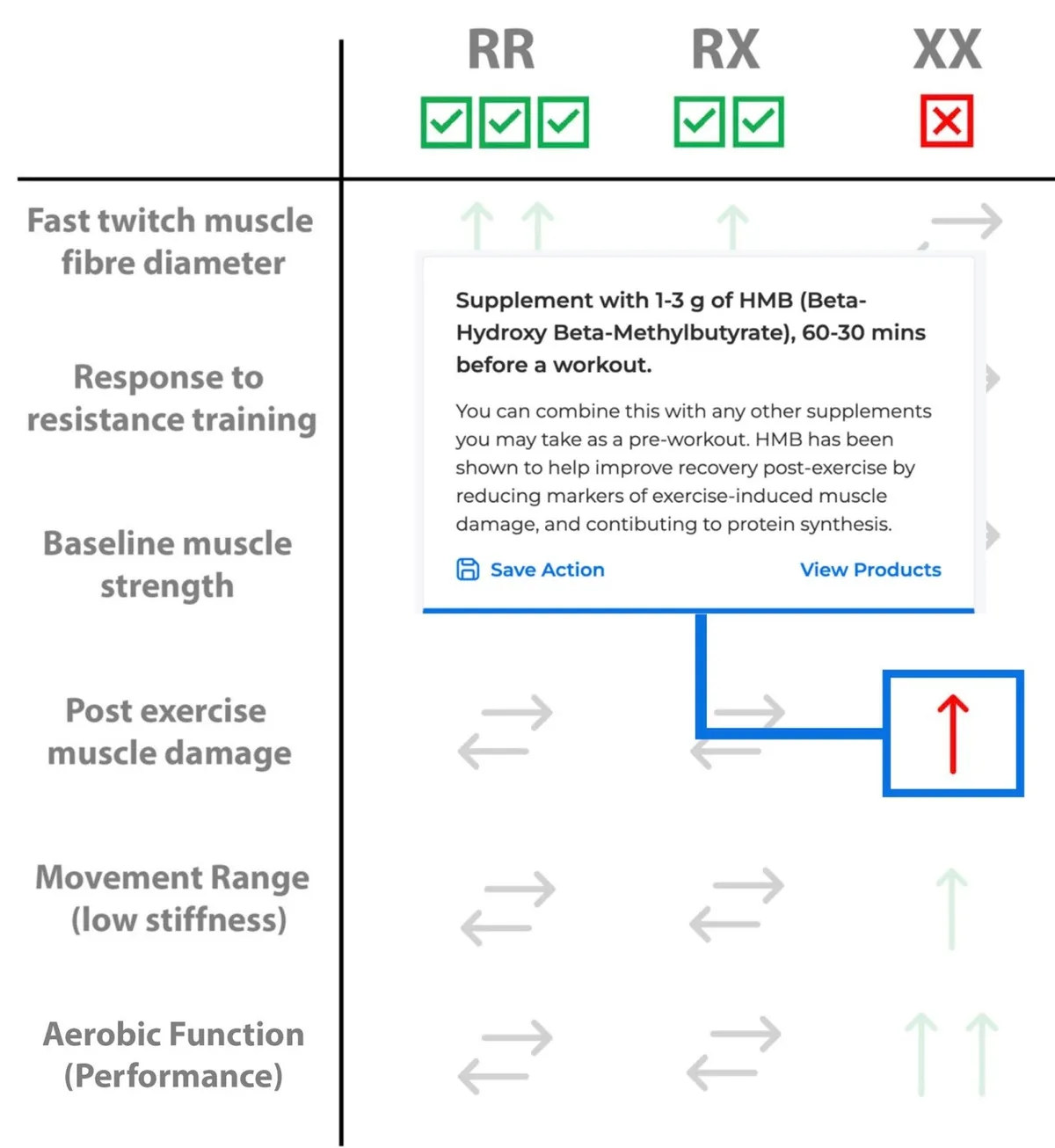
Another option to improve post-exercise recovery is HMB (Beta-Hydroxy Beta-Methylbutyrate). Taking HMB pre-exercise has been shown to reduce markers of exercise-induced and can also contribute to protein synthesis (the building of muscle).
Does the ACTN3 gene impact men and women differently?
The genotypic and allelic frequency of ACTN3 genes have been shown to be distributed similarly in men and women across the population. In other words, being male or female does not determine whether someone produces this protein.
What can differ is how these genetic traits show up in the body:
- In women, genetic differences (like ACTN3 variants) can sometimes be more noticeable because lower testosterone levels mean there is less hormonal “override” of muscle development.
- In men, higher testosterone can promote muscle mass and power regardless of genotype, which can make genetic differences less obvious.
The research, particularly in elite-level athletes, has predominately been done on males which can lead to some male-biased effects such as weaker associations in females which may be more down to lower participant numbers compared to males.
Citations
Simoneau JA, Bouchard C. Genetic determinism of fiber type proportion in human skeletal muscle. FASEB J. 1995 Aug;9(11):1091-5. doi: 10.1096/fasebj.9.11.7649409. PMID: 7649409.
Papadimitriou ID, Lucia A, Pitsiladis YP, Pushkarev VP, Dyatlov DA, Orekhov EF, Artioli GG, Guilherme JP, Lancha AH Jr, Ginevičienė V, Cieszczyk P, Maciejewska-Karlowska A, Sawczuk M, Muniesa CA, Kouvatsi A, Massidda M, Calò CM, Garton F, Houweling PJ, Wang G, Austin K, Druzhevskaya AM, Astratenkova IV, Ahmetov II, Bishop DJ, North KN, Eynon N. ACTN3 R577X and ACE I/D gene variants influence performance in elite sprinters: a multi-cohort study. BMC Genomics. 2016 Apr 13;17:285. doi: 10.1186/s12864-016-2462-3. PMID: 27075997; PMCID: PMC4831144.
Eynon N, Ruiz JR, Femia P, Pushkarev VP, Cieszczyk P, Maciejewska-Karlowska A, Sawczuk M, Dyatlov DA, Lekontsev EV, Kulikov LM, Birk R, Bishop DJ, Lucia A. The ACTN3 R577X polymorphism across three groups of elite male European athletes. PLoS One. 2012;7(8):e43132. doi: 10.1371/journal.pone.0043132. Epub 2012 Aug 16. Erratum in: PLoS One. 2014;9(3):e93165. PMID: 22916217; PMCID: PMC3420864.
Eynon N, Duarte JA, Oliveira J, Sagiv M, Yamin C, Meckel Y, Sagiv M, Goldhammer E. ACTN3 R577X polymorphism and Israeli top-level athletes. Int J Sports Med. 2009 Sep;30(9):695-8. doi: 10.1055/s-0029-1220731. Epub 2009 Jun 18. Erratum in: Int J Sports Med. 2009 Nov;30(11):839. PMID: 19544227.
Vincent B, De Bock K, Ramaekers M, Van den Eede E, Van Leemputte M, Hespel P, Thomis MA. ACTN3 (R577X) genotype is associated with fiber type distribution. Physiol Genomics. 2007 Dec 19;32(1):58-63. doi: 10.1152/physiolgenomics.00173.2007. Epub 2007 Sep 11. PMID: 17848603.
El Ouali EM, Barthelemy B, Del Coso J, Hackney AC, Laher I, Govindasamy K, Mesfioui A, Granacher U, Zouhal H. A Systematic Review and Meta-analysis of the Association Between ACTN3 R577X Genotypes and Performance in Endurance Versus Power Athletes and Non-athletes. Sports Med Open. 2024 Apr 12;10(1):37. doi: 10.1186/s40798-024-00711-x. PMID: 38609671; PMCID: PMC11014841.
Wax B, Kerksick CM, Jagim AR, Mayo JJ, Lyons BC, Kreider RB. Creatine for Exercise and Sports Performance, with Recovery Considerations for Healthy Populations. Nutrients. 2021 Jun 2;13(6):1915. doi: 10.3390/nu13061915. PMID: 34199588; PMCID: PMC8228369.
Rahimi MH, Mohammadi H, Eshaghi H, Askari G, Miraghajani M. The Effects of Beta-Hydroxy-Beta-Methylbutyrate Supplementation on Recovery Following Exercise-Induced Muscle Damage: A Systematic Review and Meta-Analysis. J Am Coll Nutr. 2018 Sep-Oct;37(7):640-649. doi: 10.1080/07315724.2018.1451789. Epub 2018 Apr 20. PMID: 29676656.
Harty, P.S., Cottet, M.L., Malloy, J.K. et al. Nutritional and Supplementation Strategies to Prevent and Attenuate Exercise-Induced Muscle Damage: a Brief Review. Sports Med - Open 5, 1 (2019). https://doi.org/10.1186/s40798-018-0176-6