There is a growing gap in the fitness industry between what the science says and what most practitioners are equipped to deliver. Personalised training and nutrition has become the dominant conversation in performance and health optimisation, yet the tools and knowledge required to truly individualise client programmes - beyond generic questionnaires and trial and error - remain out of reach for most coaches and trainers.
Genetics is where that gap is widest. And it is also where the greatest opportunity lies.
The case for genetics in client practice
Every client who walks through your door is physiologically unique. Two people can follow the same training programme, eat the same diet, and get dramatically different results. One recovers quickly and builds strength steadily; the other struggles with persistent soreness, slow adaptation, or repeated injury. Practitioners have always known this intuitively. What genetics provides is insight into the mechanisms behind it.
Variants in genes like ACTN3, influence the ratio of fast to slow-twitch muscle fibres, shaping how an individual responds to resistance training versus aerobic volume. ACE variants affect cardiovascular adaptation and whether a client will thrive on high-intensity or moderate steady-state work. PPARGC1A influences mitochondrial biogenesis - a key adaptation for improvements in aerobic fitness. COL1A1 and COL5A1 affect connective tissue integrity and injury susceptibility. TNF-α variants modulate the inflammatory response to exercise load, determining how aggressively recovery strategies need to be prioritised.
These are not all marginal differences. The HERITAGE Family Study demonstrated that 47% of the variance in VO₂max training response is heritable. A genome-wide analysis of over 470 subjects found a panel of just 21 gene variants could account for 49% of that variance, with subjects carrying the most favourable alleles (versions of the gene) improving their VO₂max by nearly three times more than those with the least favourable profile.
Recent research published in Science (2026) has redefined our understanding of the "biological clock," suggesting that longevity is approximately 50% heritable. For the fitness professional, this means that half of a client’s ageing trajectory is written in their genetic code. While we cannot change their DNA, understanding these rare variants allows us to deploy precise lifestyle and training interventions to influence the other 50%, and slow the rate of biological decline.
For a fitness professional, that data is transformative. It means the client who has plateaued for months, or the athlete who gets those recurring soft tissue injuries, or the individual who sees no return on their cardio investment, may not be failing their programme. Their programme may simply be mismatched to their biology.
Genetics does not remove the importance of effort, consistency, or coaching quality. But it adds a layer of precision that makes all of those things work harder.
A note on what genetics cannot do
Any credible course in applied genetics must also teach its limitations, and the FitnessGenes programme is explicit on this point. Single gene variants explain a small fraction of performance variance in isolation. ACTN3 accounted for less than 1% of sprint time variance in elite 200m athletes. Genetics provides signal, not prescription. The practitioner's role - their knowledge of training methodology, their understanding of the individual client, their ability to integrate multiple data sources - remains indispensable.
What genetics adds is not a replacement for coaching expertise. It is a layer of biological context that makes that expertise more precise. Used well, it is one of the most powerful tools available for individualising the client journey. Used poorly - without the scientific grounding to interpret it responsibly - it risks producing noise rather than insight.
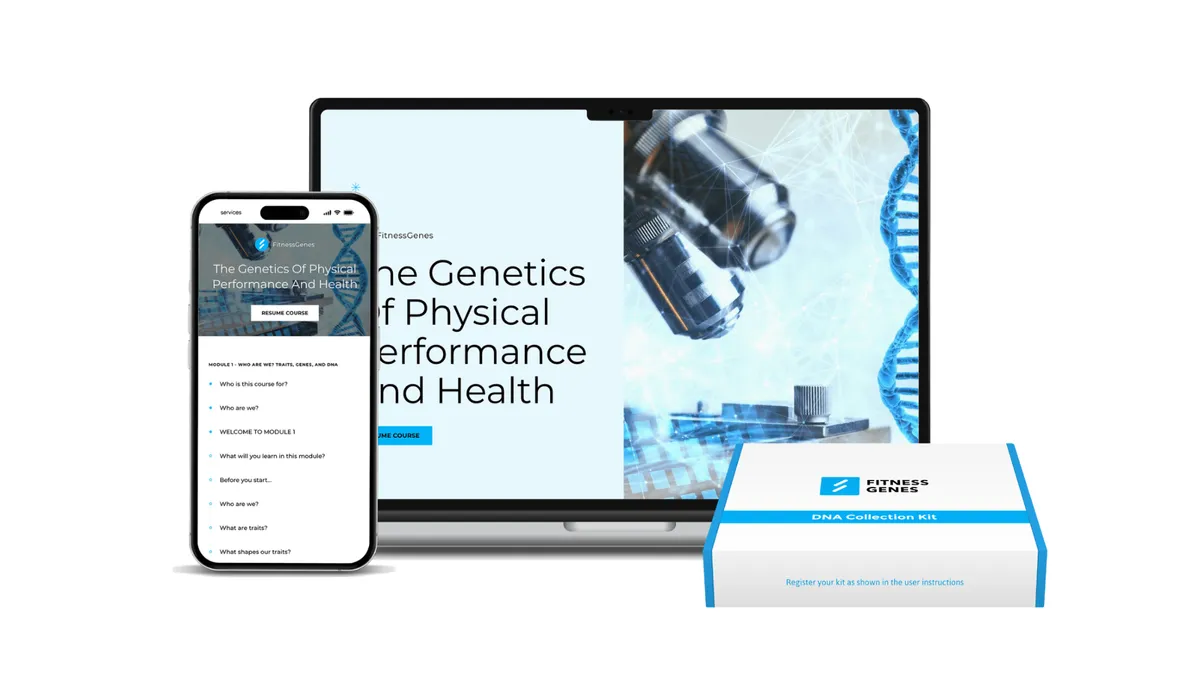
The course exists precisely to ensure practitioners can do the former. FitnessGenes has developed a dedicated professional education course - The Genetics of Physical Performance and Health - specifically designed to bridge this gap between knowledge and translation. Built by an in-house team of scientists and geneticists, the course provides practitioners with a rigorous but practically applicable foundation in sports genomics. It is the only course of its kind to have been awarded six CIMSPA CPD points.
What the course covers
The course is structured across four essential modules:
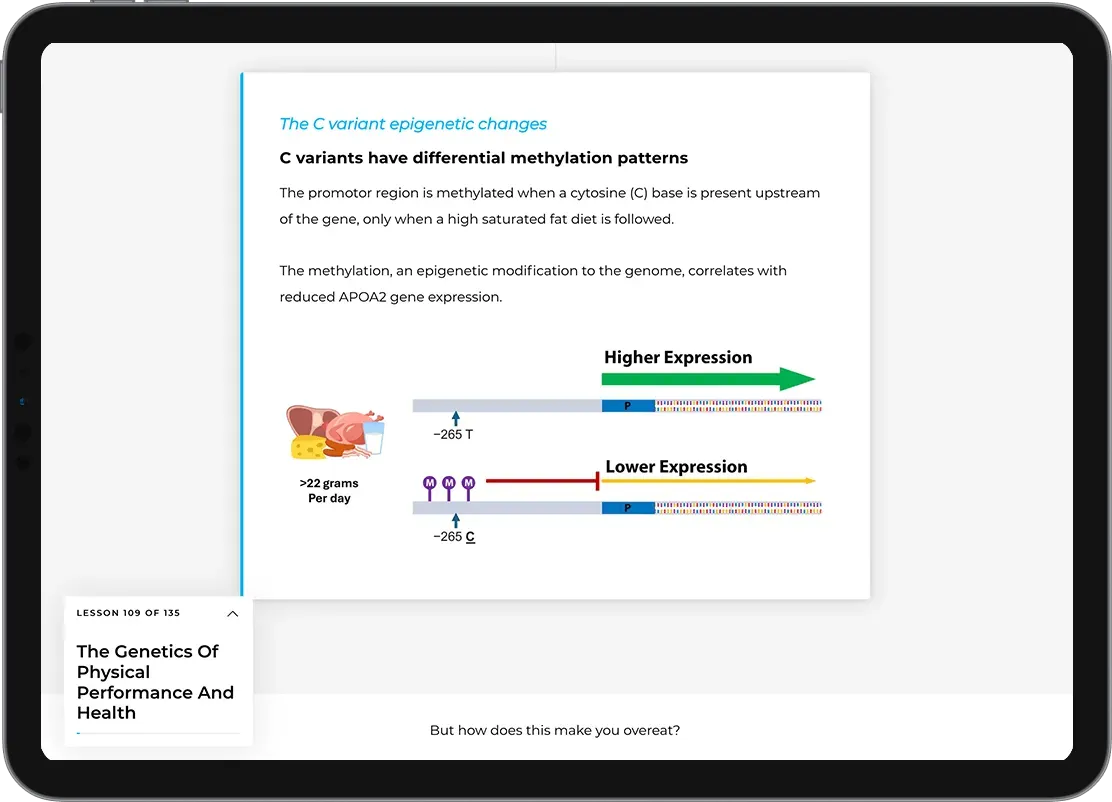
- The Foundations of Genetics: Covering DNA structure and how genetic variation arises. Understanding how a SNP creates a functional change in protein output allows you to explain to a client why their recovery requires a different approach.
- Gene variants & Performance: Moving into specific variants relevant to muscle composition, aerobic trainability, and injury risk.
- Polygenic Traits & Interactions: The concept that genes do not operate in isolation. Understanding how to interpret lifestyle and genetic data together gives you the whole picture.
- Applied Genomics in Fitness & Health: How to turn data into training structures, nutritional support, and supplementation strategies.
The commercial and professional case
The fitness industry is competitive and increasingly commoditised. Clients have more access to information than ever before, and generic coaching programmes - however well designed - are increasingly difficult to differentiate. Practitioners who can offer genuinely personalised guidance, backed by both genetic data and the expertise to interpret it, occupy a meaningfully different position in the market, which in turn can boost revenue growth.
The ability to explain to a client that their slow recovery is partially driven by genes causing elevated inflammation, and that this informs specific nutritional and supplementation strategies alongside their training periodisation, is not a gimmick. It is a level of service that most practitioners cannot currently offer. For those working in performance sport, clinical settings, or with high-value personal training clients, that distinction matters enormously.
There is also a client retention dimension. When clients understand the reasoning behind their programme - when it is connected to something as concrete and personal as their own biology - adherence improves. People train harder and more consistently when they believe their plan was built specifically for them. Genetics gives practitioners the evidence to make that case in a way that generic programme design simply cannot.
Who the course is for
The course is designed for fitness professionals and practitioners across a range of backgrounds - personal trainers, strength and conditioning coaches, sports therapists, nutritionists, and health practitioners who want to integrate genetic data into their client offering. No prior background in genetics or molecular biology is required. The course is structured to build understanding progressively, and the focus throughout is on practical application rather than academic depth for its own sake.
It is equally relevant for professionals already working with genetic testing platforms who want a more rigorous scientific foundation for their interpretations, and for those who are new to genetics entirely and want to understand whether and how it fits within their practice.
The bottom line
Personalisation in fitness is no longer just a differentiator, it is an expectation. The question is no longer whether genetics belongs in professional practice, but how quickly practitioners will build the knowledge required to use it well.
The FitnessGenes Genetics of Physical Performance and Health course offers a structured, evidence-based, and professionally accredited route to doing exactly that. For any practitioner serious about delivering the next generation of client results, it represents one of the most high-value investments available in continued professional development.
The science is there. The tools are there. The education is there. The practitioners who move first will define the standard for everyone else.
Citations
Bouchard C, Sarzynski MA, Rice TK, Kraus WE, Church TS, Sung YJ, Rao DC, Rankinen T. Genomic predictors of the maximal O₂ uptake response to standardized exercise training programs. J Appl Physiol (1985). 2011 May;110(5):1160-70. doi: 10.1152/japplphysiol.00973.2010. Epub 2010 Dec 23. PMID: 21183627; PMCID: PMC3098655.
Shenhar B, Pridham G, De Oliveira TL, Raz N, Yang Y, Deelen J, Hägg S, Alon U. Heritability of intrinsic human life span is about 50% when confounding factors are addressed. Science. 2026 Jan 29;391(6784):504-510. doi: 10.1126/science.adz1187. Epub 2026 Jan 29. PMID: 41610249.
Papadimitriou ID, Lucia A, Pitsiladis YP, Pushkarev VP, Dyatlov DA, Orekhov EF, Artioli GG, Guilherme JP, Lancha AH Jr, Ginevičienė V, Cieszczyk P, Maciejewska-Karlowska A, Sawczuk M, Muniesa CA, Kouvatsi A, Massidda M, Calò CM, Garton F, Houweling PJ, Wang G, Austin K, Druzhevskaya AM, Astratenkova IV, Ahmetov II, Bishop DJ, North KN, Eynon N. ACTN3 R577X and ACE I/D gene variants influence performance in elite sprinters: a multi-cohort study. BMC Genomics. 2016 Apr 13;17:285. doi: 10.1186/s12864-016-2462-3. PMID: 27075997; PMCID: PMC4831144.