
If You’re Already Testing Your Blood, You’re Ahead of Most People
Regular blood testing is one of the smartest health habits you can build. Whether you’re running Thriva or Medichecks panels at home every few months, or booking in-person phlebotomy through a testing provider like Bluecrest Wellness, you already understand the value of data over guesswork. You're tracking ferritin, vitamin D, cholesterol, thyroid markers - watching trends, building a picture of what makes you unique, and using it to fine-tune your diet and supplementation. You're on top of it.
So why would you need anything else?
Because blood tests answer what. DNA testing answers why - and what next.
Blood Tests Are a Snapshot. DNA Is the Manual.
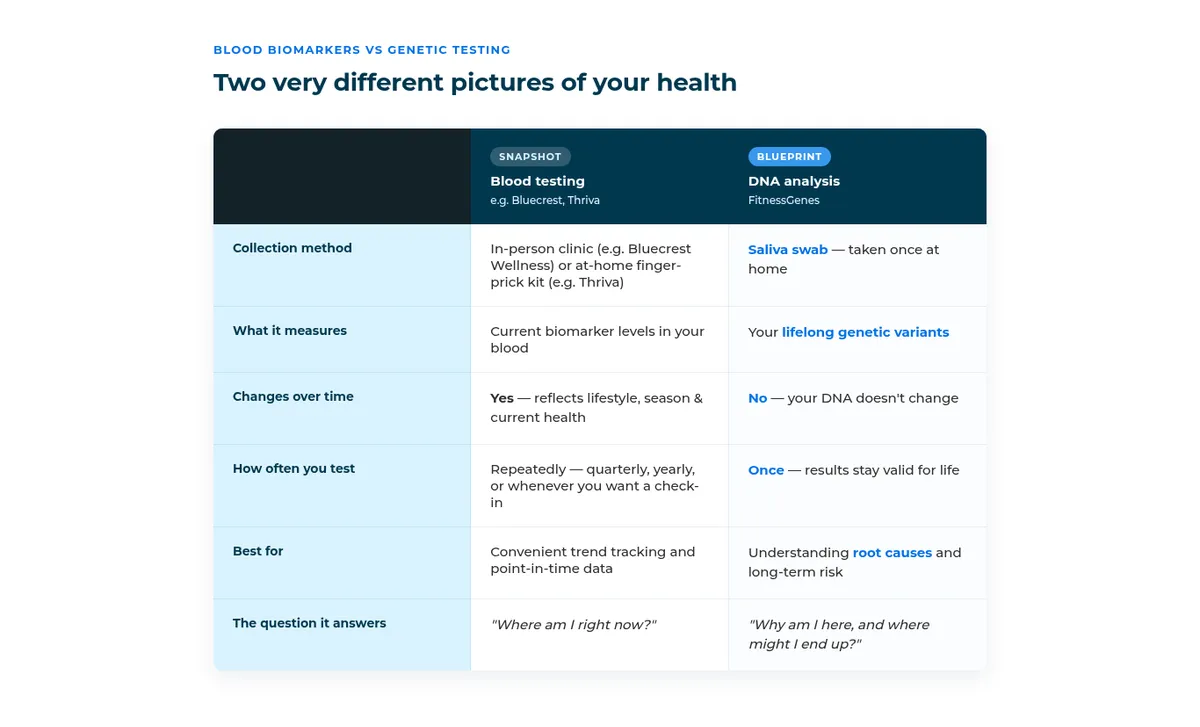
Think of a blood test as a photograph taken today. It tells you exactly where your biomarkers sit at this moment in time. That’s genuinely useful. But a photograph doesn’t tell you why the scene looks the way it does, or what it’ll look like in five years if nothing changes.
Your DNA, by contrast, is fixed. It doesn’t fluctuate with a bad week of sleep or a fortnight of Christmas excess. It’s the underlying biological context that shapes how your body processes nutrients, responds to exercise, manages inflammation, and accumulates risk over time.
The question was never DNA or blood tests. It's DNA AND blood tests - two different lenses on the same body. One fixed, one dynamic. One explaining the rules, one tracking the score.
Used together, they're the most powerful framework for proactive, personalised health you can build.
What DNA Testing Reveals That Blood Tests Can’t
VDR: The Why Behind Your Results
Take vitamin D deficiency - one of the most common findings on UK blood panels. Your Bluecrest Wellness result might show you’re low, so you supplement, and your levels climb. Job done, right?
Not quite. Variants in the VDR (Vitamin D Receptor) gene affect how efficiently your body actually uses the vitamin D it absorbs. Two people with identical blood levels can have dramatically different biological responses to that vitamin D. If you carry a less efficient VDR variant, you may need to supplement at a higher dose, for longer than the standard guidance suggests. Without DNA testing, you’d never know why you keep falling back into deficiency.
Blood tells you your level is low. DNA tells you why it keeps happening.
HFE: Hereditary Risk You Can Act On Before It Shows Up in Blood
Hereditary haemochromatosis is one of the most clinically significant examples. It's the most common genetic disorder in people of Northern European descent, affecting as many as 1 in 10 in the Northern Irish population. Carriers of certain HFE gene variants (predominantly C282Y, and in some cases H63D) absorb and store excess iron which, if left unmanaged, can lead to liver damage, joint problems, and cardiovascular complications.
It’s a genuinely life-shortening condition.
Haemochromatosis is also a progressive condition, with iron accumulating slowly, often over decades. Ferritin can be normal in early adulthood in HFE carriers, particularly in younger people and premenopausal women (menstruation offsets iron accumulation). By the time elevated ferritin shows up consistently in blood testing, iron loading has often been accumulating for years, and underlying damage has been done.
It's a point underscored by Haemochromatosis UK, the condition's dedicated charity. Identified early, the condition is manageable and not life-limiting. Knowing your HFE variant status - via genetic testing - before ferritin climbs, is what turns a serious diagnosis into a manageable one.
MTHFR: When Blood Markers and Genetics Reveal Different Parts of the Story
MTHFR variants are a useful example of why blood testing and DNA testing measure different things, and why both matter.
The MTHFR gene encodes an enzyme involved in converting folate into a form the body can use in methylation and homocysteine metabolism. Common variants, particularly C677T, can reduce that enzyme's efficiency by up to 70%, especially in people carrying two copies.
Folate and B12 work together in this pathway: active folate is needed to recycle homocysteine (a naturally occurring amino acid that, when it accumulates, is associated with increased risk of heart disease, stroke, and cognitive decline), and B12 acts as an essential cofactor in that same process.
A standard blood panel may show folate and B12 sitting within normal range, while DNA testing reveals a reduced-capacity pathway that could make those nutrients less efficiently utilised. In some individuals, this contributes to elevated homocysteine and a greater sensitivity to even modest shortfalls in folate intake, even when basic nutrient levels look adequate on paper.
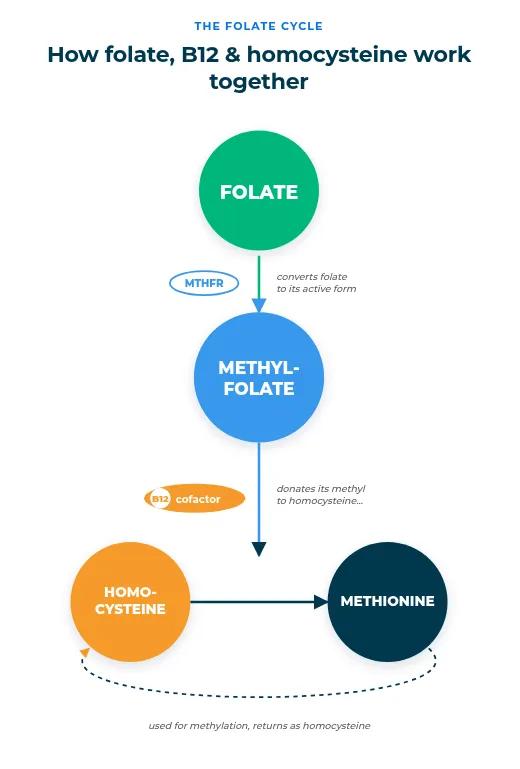
The result is that, for some individuals, symptoms such as brain fog, fatigue, and low mood may persist despite blood results that look perfectly normal, because the issue isn't the level of the nutrient, it's the body's ability to use it.
In these cases, supplementing makes sense, but the form matters as much as the dose. Switching from standard folic acid to methylated forms such as methylfolate, and in some cases methylcobalamin (the active form of B12), works meaningfully better.
Other benefits to DNA testing
Know Which Blood Tests Are Actually Worth Your Money
This might be the most underrated benefit of DNA testing for regular health testers: it prioritises your blood testing.
Not every marker matters equally for every person. If you carry variants associated with elevated LDL cholesterol or altered lipid metabolism, quarterly lipid panels are a smart investment for you specifically. If your genetics suggest lower cardiovascular risk and strong lipid regulation, you might redirect that budget toward markers that are more relevant to your profile.
Genetic testing doesn’t replace blood testing, but it will tell you which parts of those panels deserve the closest attention, and which additional tests are worth adding based on your actual genetic risk profile.
A Lifetime of Value
DNA testing is, arguably, the best value health investment you can make. Unlike blood testing, which you repeat quarterly, annually, or whenever something flags, you only ever sequence your DNA once. Your genome doesn't change. The report you get today is as valid in ten years as it is now, and every insight it contains compounds in value as your health picture evolves. A one-time cost. A lifetime of context.
The Bottom Line
Genetic testing and blood testing aren't either/or. They operate on different timescales, answer different questions, and together build something neither can alone.
If you're already using Thriva, Bluecrest, or any other blood testing provider, you've invested in knowing your numbers. FitnessGenes is the investment in understanding them, and in knowing which numbers matter most for you, specifically.
Your blood tests become smarter when you know which results to prioritise. Your genetic insights become actionable when you're tracking the biomarkers your DNA flags as relevant. Used together, they're the most complete picture of your health you can build.
For anyone serious about proactive health management, that context isn't optional. It's the difference between responding to results and actually understanding them.
The FitnessGenes Difference
Most genetic testing stops at your DNA. FitnessGenes goes further. Our plaftorm is the only one of its kind to combine genetic analysis with blood testing data, producing recommendations that are more precise and more personalised than either can deliver alone.
It's an approach so innovative that we've successfully patented it, meaning no other genetic testing company can offer the same combination of genetic and blood data in a single analysis.