
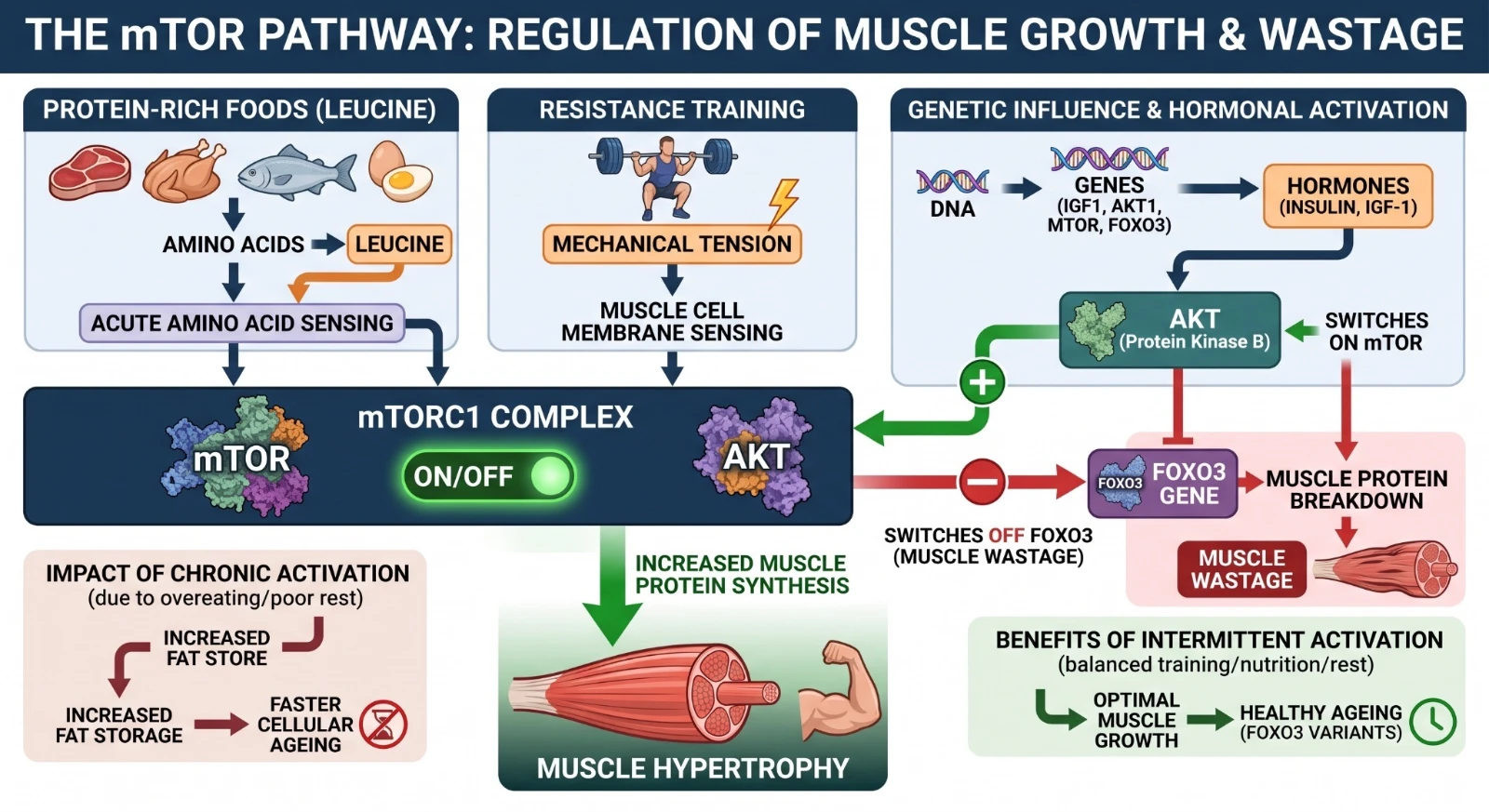
mTOR is a switch inside your muscle cells that decides whether to build new tissue or break it down. When you lift weights, mTOR is activated by mechanical tension and amino acids, triggering muscle protein synthesis and, over time, hypertrophy. Your genes influence how sensitive this switch is - which is partly why identical training programmes produce different results in different people.
If you train hard and take your nutrition seriously, understanding your own version of this switch is the next step to achieving great results.
What is mTOR, and why does it matter for building muscle?
mTOR (mechanistic target of rapamycin) is an enzyme that switches other proteins on and off - it sits at the centre of two signalling complexes, mTORC1 and mTORC2. mTORC1 matters the most for hypertrophy. Think of it as a control centre inside every muscle cell, constantly checking for signals: Are you lifting something heavy? Have you eaten enough protein? Are your hormone levels where they should be? When enough of these signals show up at once, mTORC1 switches on protein synthesis machinery and tells the cell to start making new muscle protein. Without those signals, the cell stays in maintenance mode rather than growing - which is why training and eating both need to be in place.
How does resistance training switch mTOR on?
When you lift weights, your muscles experience tension and small amounts of muscle damage. Your body picks up on this and uses it as a trigger to switch mTOR on. A 2025 review of strength-training studies found that this process, alongside the activation of "repair cells" in muscle called satellite cells, is central to muscle repair, hypertrophy, and strength gains (Rong et al., 2025). This effect doesn't last forever - it fades within a day or two - which is why regular, repeated training sessions, rather than one big workout, are what actually build muscle over time.
Does cardio cancel out your muscle-building gains?
Not really, and that's good news if you do both. Weight training switches on the mTOR pathway for building muscle, while cardio switches on a different pathway that improves your body's energy-producing "engine" (your mitochondria). It was long assumed that doing both together would blunt muscle gains, but a 2024 research review found that combining the two can actually work well together rather than against each other (Zhao & Gao, 2024). In practice, this means well-structured training that combines lifting and cardio doesn't have to come at the cost of muscle growth.
Can your DNA affect how strongly your mTOR pathway responds to training?
Genetics plays a substantial role in baseline muscle mass and in how muscle responds to training. Research suggests genetics factors account for roughly 50 to 80% of the difference between people in how much muscle they naturally carry, and in how much they gain from training (Puthucheary et al., 2011). Much of this comes down to how sensitive your personal version of the mTOR switch is. Hormones like insulin and IGF-1 activate a protein called AKT, which switches mTOR on - and, at the same time, tells a "muscle-wasting" gene called FOXO3 to stay quiet. In other words, the same system that builds muscle is also what stops it being broken down. Small genetic differences in this system - in the MTOR gene itself, plus AKT1, IGF1 and FOXO3 - can make it more or less responsive, which is part of why identical training plans don't produce identical results.
A FitnessGenes DNA analysis looks at variants across these genes as part of our muscle-building category, helping to explain your personal growth response and giving you a more tailored starting point for training, protein intake and recovery.
Order a DNA analysis here.
Do mTOR gene variants affect fat storage and ageing, as well as muscle gains?
This is where it gets interesting: the mTOR switch isn't only involved in muscle. It also plays a role in how your body stores fat, and in the ageing process.
When mTOR is switched on almost constantly - for example, from consistently eating more than your body needs without enough rest - it's linked to increased fat storage (Park et al., 2025; Lee et al., 2022). It's also connected to faster cellular ageing. In a well-known study, mice given a drug that switches mTOR off lived measurably longer, even when the treatment didn't start until later in life (Harrison et al., 2009), and scientists are now studying similar approaches in humans (Mannick & Lamming, 2023).
The FOXO3 gene mentioned above - the one that gets quietened when mTOR switches on - carries specific variants linked to exceptional lifespan across several population studies, and these variants appear to directly affect how FOXO3 behaves in muscle tissue specifically (Frankum et al., 2021). So the same pathway that helps you build muscle in your 20s and 30s is one that scientists are studying closely for its role in healthy (or not so healthy) ageing decades later - which is a good reason to think about recovery, not just effort, as part of your training.
What should you actually do with this information?
You don't need to obsess over "activating mTOR" at every meal. The basics still matter most: workouts that progressively challenge you, decent amounts of protein spread through the day (particularly protein rich in leucine, an amino acid that's especially good at triggering this pathway), and proper rest between sessions. Constantly overeating or training without recovery keeps this pathway switched on in a way that's linked more to fat gain than extra muscle. Knowing your own genetic tendencies can help you fine-tune these basics - for example, whether you're likely to need more training volume, tighter protein timing, or longer recovery to see the same results as someone else.
FAQs
What foods or nutrients activate mTOR?
Protein-rich foods, especially those high in an amino acid called leucine (found in meat, eggs, dairy and whey protein), are the strongest food-based trigger for this pathway. Adequate total protein intake, combined with insulin's role in nutrient delivery - insulin helps carry amino acids out of your bloodstream and into your muscle cells - also supports mTOR activation after meals.
Is more mTOR activation always better for muscle growth?
No. mTOR activation needs to be triggered repeatedly through training and nutrition, but chronic, constant activation (from continuous overfeeding or insufficient recovery) is linked to fat storage and cellular stress rather than additional muscle growth. Growth responds better to a cycle of stimulus and recovery than to permanently maximised signalling.
Does fasting or caffeine affect it?
Fasting reduces mTOR activity because it removes the amino acid and insulin signals that switch it on, which is part of why prolonged fasting isn't ideal immediately around training if the goal is hypertrophy. Caffeine's effects on mTOR are indirect and mainly relate to improved training performance rather than a direct signalling effect.
Can I find out how my own genes affect this?
Yes. A FitnessGenes DNA analysis includes the genes involved in this pathway - MTOR, AKT1, IGF1 and FOXO3 - as part of your muscle-building results, along with personalised training and nutrition guidance based on what they show.
Does age reduce how well mTOR responds to training?
Yes, a phenomenon often called "anabolic resistance." Older muscle tends to need a larger protein stimulus (particularly leucine) and consistent resistance training to achieve the same level of mTOR activation and muscle protein synthesis as younger muscle.
Does creatine play a role here too?
Creatine's main job is topping up the energy your muscles use during hard efforts, which lets you train harder and create a stronger stimulus for growth. It may support this pathway indirectly, but its real benefit comes from helping you perform better in the gym.
References
Rong W, Geok SK, Samsudin S, Zhao Y, Ma H, Zhang X. (2025). Effects of strength training on neuromuscular adaptations in the development of maximal strength: a systematic review and meta-analysis. Scientific Reports, 15(1), 19315. https://doi.org/10.1038/s41598-025-03070-z
Zhao YC, Gao BH. (2024). Integrative effects of resistance training and endurance training on mitochondrial remodeling in skeletal muscle. European Journal of Applied Physiology, 124(10), 2851-2865. https://doi.org/10.1007/s00421-024-05549-5
Puthucheary Z, Skipworth JRA, Rawal J, Loosemore M, Van Someren K, Montgomery HE. (2011). Genetic influences in sport and physical performance. Sports Medicine, 41(10), 845-859. https://doi.org/10.2165/11593200-000000000-00000
Park JY, Kim RW, Lee J, Jung WK, Je JY, Lee SJ. (2025). Nanosphere loaded with curcumin attenuates adipogenesis and lipid metabolism by modulating AKT/mTORC1/PPARγ phosphorylation. Tissue & Cell, 97, 103112. https://doi.org/10.1016/j.tice.2025.103112
Lee SY, Chung KS, Son SR, et al. (2022). A Botanical Mixture Relieves Obesity via the AMPK Signaling Pathway in 3T3-L1 Adipocytes and HFD-Fed Obese Mice. Nutrients, 14(18), 3685. https://doi.org/10.3390/nu14183685
Harrison DE, Strong R, Sharp ZD, et al. (2009). Rapamycin fed late in life extends lifespan in genetically heterogeneous mice. Nature, 460(7253), 392-395. https://doi.org/10.1038/nature08221
Mannick JB, Lamming DW. (2023). Targeting the biology of aging with mTOR inhibitors. Nature Aging, 3(6), 642-660. https://doi.org/10.1038/s43587-023-00416-y
Frankum R, Jameson TSO, Knight BA, et al. (2021). Extreme longevity variants at the FOXO3 locus may moderate FOXO3 isoform levels. GeroScience, 44(2), 1129-1140. https://doi.org/10.1007/s11357-021-00431-0