Yes - up to a point. What your genes mostly decide isn't your VO2 max itself, but your trainability: how much your VO2 max improves for a given amount of training. Studies put that figure at up to 47%. FitnessGenes' VO2 Max Trainability report looks at up to 20 gene variants - including ACSL1, AMPD1 and ACE - and uses them to place you into a low, average, or higher responder band, so you know what kind of results to expect and how to train around them.
Ever followed the exact same programme as a training partner and made a fraction of their progress? Your genes may be part of that story and once you know your pattern, it's one you can train around.
What is VO2 max, and why does everyone respond differently to the same training?
VO2 max is the maximum rate at which your body can take in and use oxygen during hard exercise. It's the gold-standard measure of aerobic fitness, and one of the strongest predictors of long-term cardiovascular health and lifespan.
But it's not VO2 max itself that your genes mostly decide - it's your trainability. Trainability means how much your VO2 max improves for a given amount of training, and it varies hugely between people, even on the exact same programme. In the HERITAGE Family Study, 473 sedentary adults completed an identical 20-week aerobic programme. The heritability of their VO2 max gains — in other words, how much of the difference between people came down to DNA rather than lifestyle — was estimated at 47%. For a lot of us, genetics substantially shapes how much a given amount of training pays off.
What genes influence VO2 max trainability?
No single gene determines your response to aerobic training. But research has identified specific variants that are consistently associated with larger or smaller gains. Three of the most studied are ACSL1, AMPD1, and ACE.
What does ACSL1 (rs6552828) do?
ACSL1 (acyl-CoA synthetase long-chain family member 1) makes an enzyme that helps your body break down fat for energy - one of the core processes behind aerobic fitness. In a genome-wide study of the same HERITAGE participants (a genome-wide association study, or GWAS, scans your entire genetic code for links to a trait, rather than testing one gene at a time), a single variant in ACSL1 called rs6552828 showed the strongest link to VO2 max trainability of any variant tested, accounting for roughly 6% of the training response on its own.
Researchers then combined ACSL1 with 20 other variants into one panel of 21 SNPs - a SNP (pronounced “snip”) is simply a single-letter difference in your DNA at a specific spot. Together, this panel explained 49% of the difference in VO2 max trainability between people. The practical gap was striking: people carrying 9 or fewer favourable variants across the panel gained an average of 221 ml/min in VO2 max, while those carrying 19 or more gained 604 ml/min - following the exact same programme.
What does AMPD1 (rs17602729) do?
AMPD1 (AMP deaminase 1) makes an enzyme in your muscles that helps manage energy production during exercise, especially when you're pushing hard. A change in this gene, called C34T, reduces or switches off the enzyme: people carrying the T version make less of it, which has been linked to lower exercise capacity, while the CC version keeps the enzyme working normally.
A 2022 meta-analysis pooling 43 studies (almost 4,000 endurance athletes and nearly 11,000 controls) found the AMPD1 CC genotype turned up significantly more often in elite long-distance runners and road cyclists than in sedentary controls - one of the strongest links found in that analysis, roughly twice as common in athletes as in controls (pooled odds ratio 2.23). It's worth being clear about what this actually shows, though: it tells us who's more likely to become an elite endurance athlete, not how much any individual's VO2 max will improve from training. Those are related questions, but not the same one - the same distinction that matters for genes like ACTN3 in power sport. We've included it here because it reinforces AMPD1's role in aerobic performance more broadly, alongside its place in trainability panels.
It's worth knowing the scale of this field, too. A 2017 review of the research so far looked across 35 studies and 15 different groups of people and found 97 genes proposed as possible predictors of VO2 max trainability, but only 13 of those had been confirmed by more than two independent research teams. AMPD1 is one of the better-evidenced ones, which is why it earns a place in multi-gene trainability panels.
What does ACE (rs4343) do?
ACE (angiotensin-converting enzyme) helps regulate blood pressure and how efficiently your circulation works - both relevant to how well oxygen-rich blood reaches your muscles during aerobic exercise. ACE is usually studied through a variant called I/D (insertion/deletion), where the I version tends to show up more often in endurance-oriented people and the D version more often in power-oriented people. rs4343 is a different kind of marker in the same gene, used on modern DNA testing platforms as a stand-in for I/D, because I/D itself is a larger structural change that's harder to test for directly.
That endurance link has decent evidence behind it: the same 2022 meta-analysis found the ACE II genotype was significantly more common in elite long-distance runners and road cyclists than in controls. As with AMPD1 above, this tells us about who becomes an elite endurance athlete - not directly about how much any one person's VO2 max will improve from training. Those are related but different questions, and it's the second one that a trainability panel is built to answer. ACE earns its place in the panel as one useful input, not a standalone verdict.
What does the science say about combining these genes into a trainability score?
In 2013, researchers went a layer deeper and asked which biological systems - not just individual genes - carried the most weight for VO2 max trainability. Two stood out: how efficiently your cells produce energy from fat, and parts of your immune system involved in inflammation and blood clotting. In plain terms, how well your body burns fat for fuel looks to matter just as much for trainability as any single gene does which fits neatly with ACSL1's role in fat metabolism, described above.
That bigger picture matches the 2017 review mentioned above: with 97 candidate genes identified and only a few independently confirmed, VO2 max trainability looks like a trait shaped by many genes working together - scientists call this polygenic - rather than one gene doing the heavy lifting. The 2011 GWAS on VO2 max trainability sums this up: a genetic score built from 21 variants can tell low and high responders apart by at least threefold, which lines up closely with the 221 ml/min versus 604 ml/min gap seen in the original HERITAGE study this paper builds upon. That's why our report looks at up to 20 variants, rather than basing your result on a single gene.
What do the three response bands actually mean?
Rather than reporting on individual variants one by one, the VO2 Max Trainability report combines your results into one of three bands: lower, average, or higher responder.
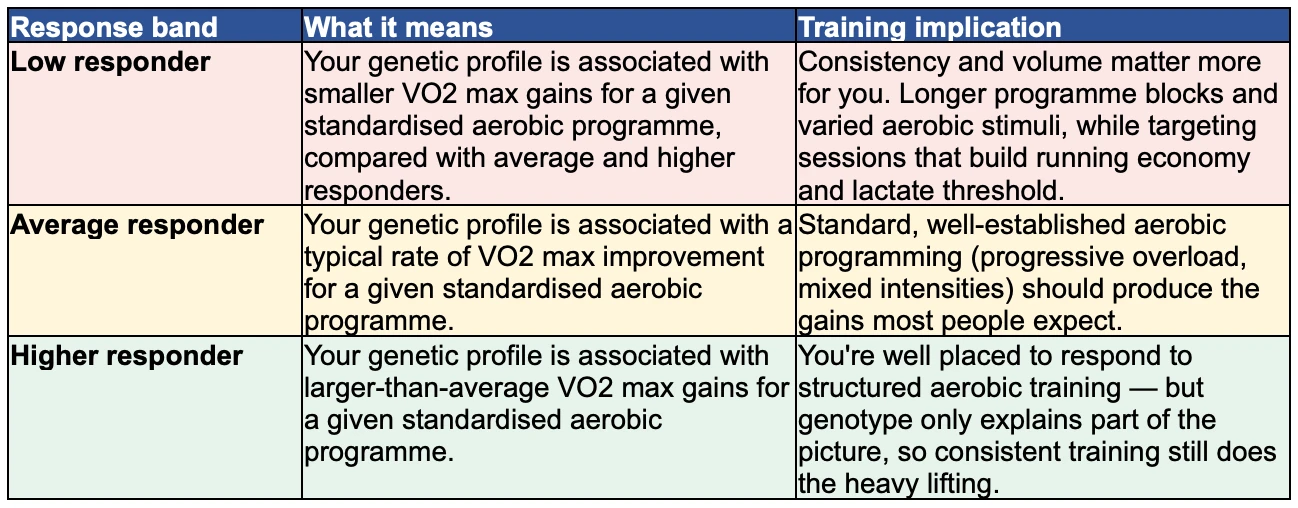
For context, the spread seen in the original HERITAGE study - 221 ml/min at the lower end of the panel score versus 604 ml/min at the higher end - shows just how differently two people can respond to an identical programme. Your own result shows where your genes sit within that kind of range, not a guaranteed personal outcome.
How should you train if you're a lower VO2 max responder?
A low responder result doesn't mean your VO2 max can't improve. It means you may need more consistent volume, or a longer block of training, to see the same gains that an average or higher responder might see sooner. Genetics is only part of the story - how you train still accounts for well over half of the difference in trainability.
In practice, that means giving your programme a longer runway rather than judging it after a few weeks. You can also look to focus on other aspects of endurance performance such as running economy and lactate threshold in your training. Improving these will help see increases in overall performance, even if your VO2 max is lagging behind a little.
FAQs
Does a “low responder” result mean I can't improve my VO2 max?
No. It means your genes are linked to smaller gains from a standard programme - not an inability to improve. Training consistency, volume, and programme design still account for most of the difference in how much your VO2 max changes, whatever your genotype.
How many genes does the VO2 Max Trainability report look at?
Up to 20, including ACSL1, AMPD1, and ACE, rather than just one. Research shows VO2 max trainability is shaped by many genes working together, so combining variants into a single panel score captures more of the picture than any one gene could alone.
Is VO2 max trainability the same thing as VO2 max itself?
No. VO2 max is your current aerobic capacity, shaped mainly by your training history and lifestyle. Trainability is different: it's how much your VO2 max is likely to improve from a given amount of training, and that responsiveness is the part with the stronger genetic link.
Can lifestyle override a “low responder” genotype?
Genetics sets a tendency, not a limit. Consistent training, good recovery, and sticking with a programme remain the biggest drivers of VO2 max improvement for everyone. A low responder result is a cue to adjust your expectations and timeline - not a reason to expect less of yourself.
Why do some studies find different results for the same gene?
Exercise genetics studies often use small groups of people, focus on specific populations, and follow different training protocols. A 2017 review found only 13 of 97 candidate genes had been confirmed by more than two independent research teams - exactly why multi-gene panels are more reliable than single-gene claims.
Does the ACE gene decide if I'm built for endurance or power?
Not on its own. ACE's I/D variant has been linked to endurance- or power-oriented profiles in some studies, but the evidence tying it specifically to VO2 max trainability is more mixed than for genes like ACSL1. It's best read as one useful input, not a category that defines you.
How reliable is genetic testing for exercise response right now?
It's a genuinely developing field. Panels that combine several well-studied genes - like the one behind the VO2 Max Trainability report - perform better than single-gene tests, but genetics is only one part of a bigger picture that includes training, nutrition, sleep, and consistency. Combining the understanding of your genetics alongside the knowledge of a skilled coach can help you build the best plan for you.
Decode Your Trainability. Train With Purpose.
Your DNA already contains the pattern - a FitnessGenes analysis just decodes it. Your VO2 Max Trainability result won't do the workout for you, but it tells you what kind of response to expect, and how to shape your training around it.
Read your biology. Train with intention.
Find out your VO2 max trainability and get your personalised training plan
Citations
Bouchard C, Sarzynski MA, Rice TK, Kraus WE, Church TS, Sung YJ, Rao DC, Rankinen T. Genomic predictors of the maximal O2 uptake response to standardized exercise training programs. J Appl Physiol (1985). 2011 May;110(5):1160-70. doi: 10.1152/japplphysiol.00973.2010. PMID: 21183627; PMCID: PMC3098655.
Williams CJ, Williams MG, Eynon N, Ashton KJ, Little JP, Wisloff U, Coombes JS. Genes to predict VO2max trainability: a systematic review. BMC Genomics. 2017 Nov 14;18(Suppl 8):831. doi: 10.1186/s12864-017-4192-6. PMID: 29143670; PMCID: PMC5688475.
Ghosh S, Vivar JC, Sarzynski MA, Sung YJ, Timmons JA, Bouchard C, Rankinen T. Integrative pathway analysis of a genome-wide association study of (V)O2max response to exercise training. J Appl Physiol (1985). 2013 Nov 1;115(9):1343-59. doi: 10.1152/japplphysiol.01487.2012. PMID: 23990238; PMCID: PMC3841836.
Bouchard C. Genomic predictors of trainability. Exp Physiol. 2012 Mar;97(3):347-52. doi: 10.1113/expphysiol.2011.058735. PMID: 21967902.
Konopka MJ, van den Bunder JCML, Rietjens G, Sperlich B, Zeegers MP. Genetics of long-distance runners and road cyclists—A systematic review with meta-analysis. Scand J Med Sci Sports. 2022 Oct;32(10):1414-1429. doi: 10.1111/sms.14212. PMID: 35839336; PMCID: PMC9544934.
Bouchard C, An P, Rice T, Skinner JS, Wilmore JH, Gagnon J, Pérusse L, Leon AS, Rao DC. Familial aggregation of VO(2max) response to exercise training: results from the HERITAGE Family Study. J Appl Physiol (1985). 1999 Sep;87(3):1003-8. doi: 10.1152/jappl.1999.87.3.1003. PMID: 10484570.