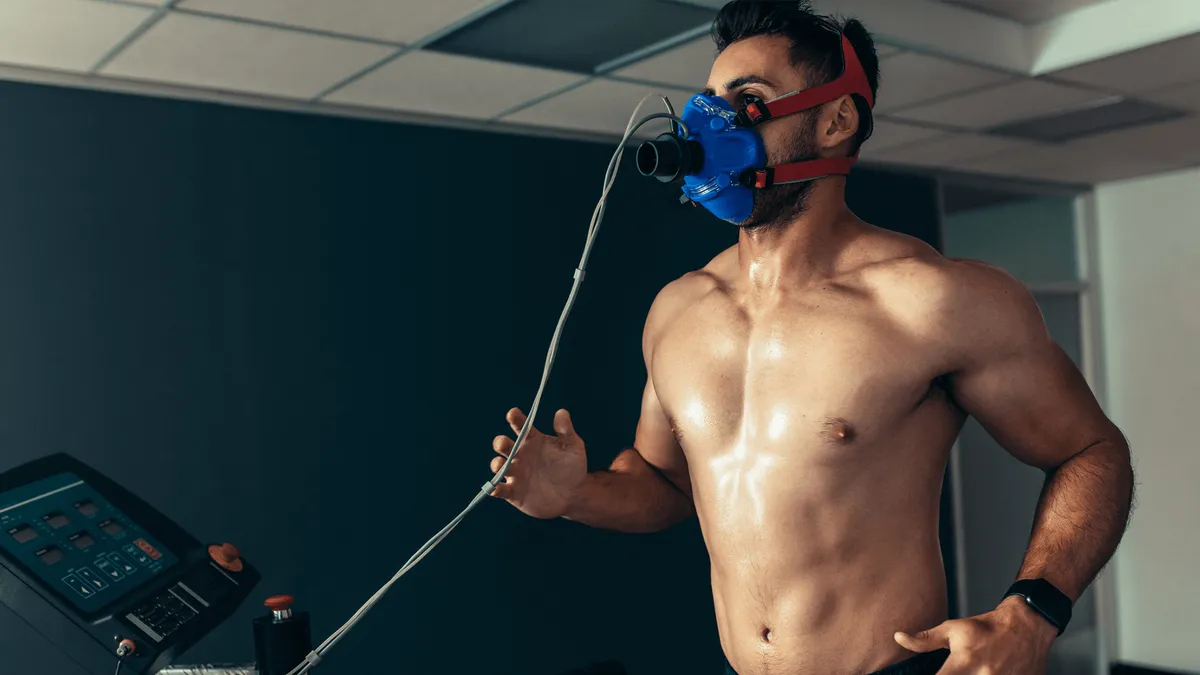
What is VO2 max?
Your VO2max is the maximum amount of oxygen your body can use during exercise. Your body converts the oxygen you breathe into a source of energy known as adenosine triphosphate (ATP), which fuels your muscle contraction. The greater your capacity to deliver oxygen to your muscles and the better your muscles are at extracting and using that oxygen to generate ATP, the longer you can sustain higher-intensity exercise. A high VO2max is therefore a strong predictor of endurance performance.
Measuring your VO2max is a useful way to gauge your aerobic fitness and track improvement over time. But it isn't just a number for athletes: research has linked higher VO2max to a lower risk of cardiovascular disease and all-cause mortality (Salier Eriksson et al., 2021), so raising it is worth doing for general health as well as performance.
3 ways to measure your VO2max
1. VO2max Test
The most accurate (albeit not the most accessible) way to measure your VO2max is a lab-based test. You wear a mask and a heart rate monitor to track oxygen and carbon dioxide exchange as you exercise on a treadmill or bike. Protocols vary, but most involve a short warm-up followed by small, regular increases in speed or incline (or resistance, on a bike) until you reach exhaustion. Your VO2max is then calculated as:
VO2max = maximum amount of oxygen consumed in 1 minute (millilitres)/body weight in kilograms
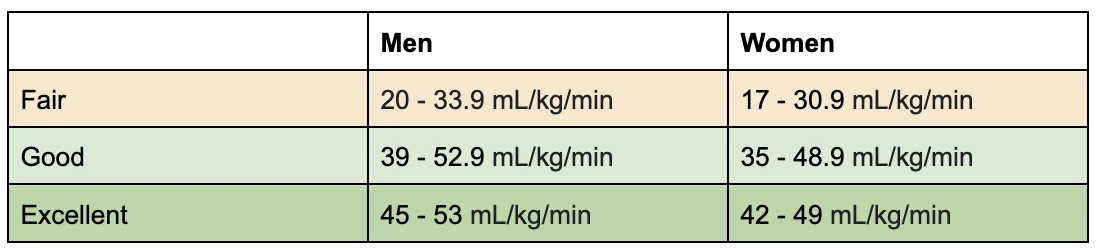
This gives a score in mL/kg/min - the more oxygen your body can use relative to your body weight, the longer you can work at a higher intensity. Here are a few example score ranges for men and women (nonathletes) between the ages of 20 and 49:
2. Wearable data
Devices like Garmin and Apple Watch can estimate your VO2max by tracking heart rate and pace during a brisk walk or run. This isn't as accurate as a lab test, since it estimates rather than directly measures oxygen use, but it's a reasonable proxy if a lab test isn't practical - and it's consistent enough over time to help you track trends.
3. Submaximal exercise tests
Submaximal exercise tests are an alternative method to lab testing which can be carried out at home or by certified fitness instructors.
3a. The Cooper run
The Cooper run test is thought to be an easy method to measure VO2max and aerobic fitness. The test is carried out over 12 minutes and requires you to run (or walk if that’s more your speed) as far as you can in 12 minutes. Make sure to warm up before you start! After completing the 12-minute run/walk, you can use one of the equations below to calculate your VO2max, depending on whether you measured your run in miles or kilometres.
(22.351 x distance covered in 12 minutes in kilometres) - 11.288 = VO2max
(35.97 x distance covered in 12 minutes in miles) - 11.29 = VO2max
3b. The Rockport 1-mile walk test
The Rockport 1-mile walk test has similarities to the Cooper run test but the calculation takes into account more factors such as your weight and age. To carry out this test you need to walk for exactly 1 mile (on a level track/level surface) as fast as you can. Record your walking time in minutes using decimals (for example 7 minutes 30 seconds would be recorded as 7.5), and take your heart rate. You can then calculate your VO2max using the following equation:
132.853 - (0.0769 x weight in pounds) - (0.3877 x age) + (6.315 if male or 0 if female) - (3.2649 x walking time) - (0.1565 x heart rate)
3c. 20 m multistage fitness test (beep test)
The beep test, a common test carried out in many secondary schools in the UK, is another way we can measure our VO2max. To carry out this test, you need to set up two markers 20 m apart and “the beep test” audio (which can be found on Youtube). Run back and forth between the markers in time with the beeps, which come progressively faster as you advance levels. The highest level you reach converts to an estimated VO2max via a standard conversion chart.
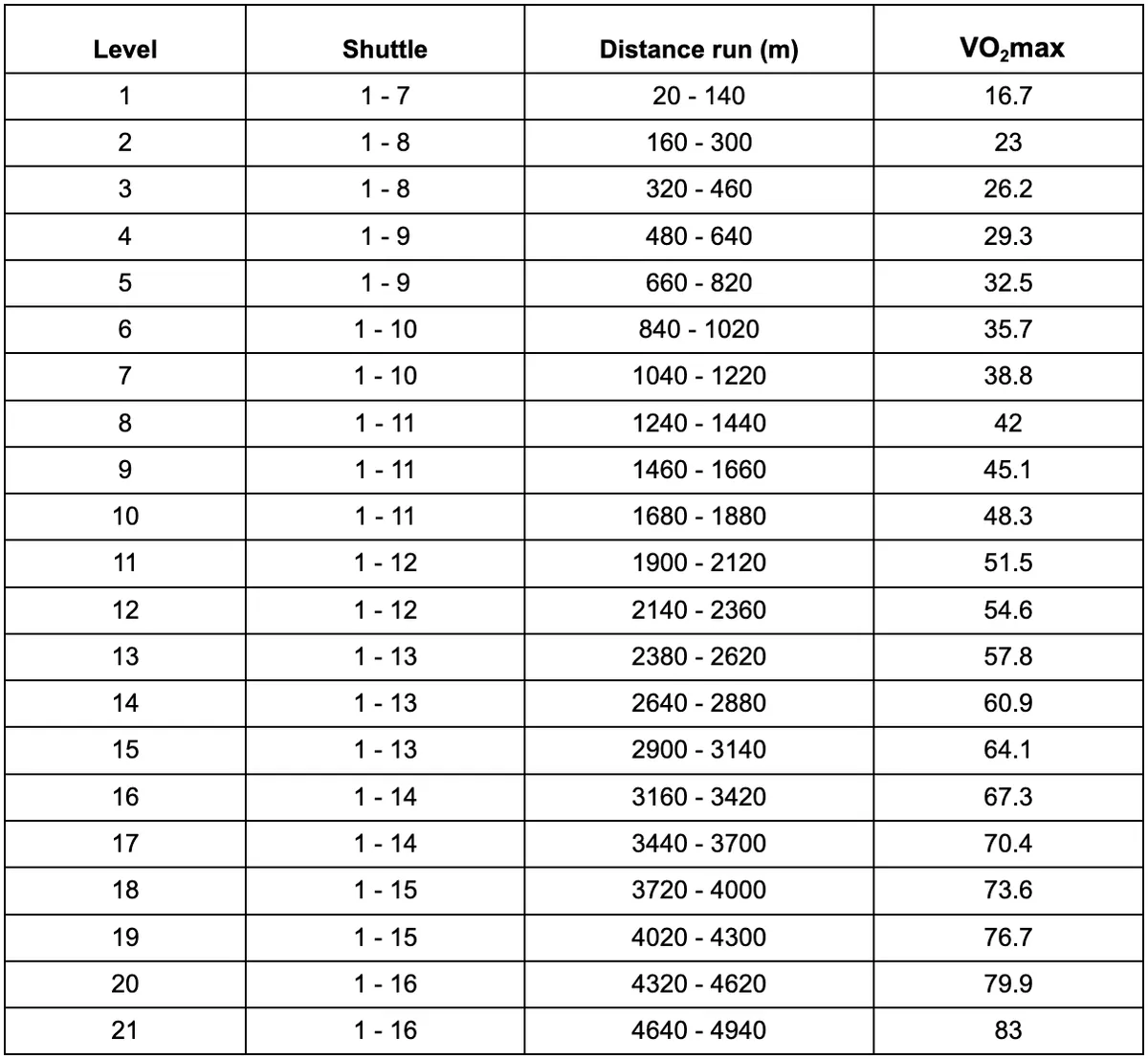
These are a few accessible ways to gauge your VO2max and track progress over time. It's worth noting that a single VO2max number matters less than the trend - retesting every 8-12 weeks with the same method gives a much clearer picture of progress than comparing scores across different test types, which don't always agree with each other.
How can you improve your VO2max?
VO2max responds well to training, particularly high-intensity interval training (HIIT) and sustained aerobic ("zone 2") work, which improve both how much oxygen your heart can pump and how efficiently your muscles use it. Consistency matters more than any single session - most people see measurable improvement over 8-12 weeks of regular training. How much you improve, though, partly comes down to genetics: some people respond much more readily to endurance training than others.
Discover how your VO2max responds to training
Want to know if you are a low, average or high responder to high-intensity endurance training? VO2 Max Trainability is just one of 135+ genetic reports that is including in your FitnessGenes DNA analysis test.
References
All about vo2max: For athletes, Exercisers & Health Seekers. Polar Blog. (2020, November 19). https://www.polar.com/blog/vo2max/
Bumgardner, W. (2022, August 10). Find your fitness level with a 1-Mile Walk test. Verywell Fit. https://www.verywellfit.com/rockport-fitness-walking-test-calculator-3952696#:~:text=The%20Rockport%20walking%20test%20is,ml%2Fkg%2Fmin
Capritto, A. (2022, July 15). Vo2 Max: The fitness metric that can help you run faster and work out harder. CNET. https://www.cnet.com/health/fitness/vo2-max-the-fitness-metric-that-can-help-you-run-faster-and-workout-harder/#:~:text=Elite%20male%20runners%20have%20shown,36.9%20mL%2Fkg%2Fmin
Crawford, S., & Walker-Journey, J. (2010, July 14). How VO2 max works. HowStuffWorks. https://adventure.howstuffworks.com/outdoor-activities/triathlons/training/vo2-max1.htm
Elizabeth Quinn, M. S. (2022, October 27). Cooper test: A 12-minute run to check aerobic fitness. https://www.verywellfit.com/fitness-test-for-endurance-12-minute-run-3120264
Jewell, T. (2022, October 18). VO₂ max: Definition, how it's measured, how to improve. Healthline. https://www.healthline.com/health/vo2-max#increasing-it
Kaloc, J. (2022, October 7). Can your Garmin accurately measure your VO2 max? We Love Cycling magazine. https://www.welovecycling.com/wide/2022/10/07/can-your-garmin-accurately-measure-your-vo2-max/
Noonan, V., & Dean, E. (2000). Submaximal exercise testing: Clinical application and interpretation. Physical Therapy, 80(8), 782–807.
REI. How to measure and improve your VO2 max: Rei Co-op. REI. https://www.rei.com/learn/expert-advice/how-to-measure-and-improve-your-vo2-max.html
Salier Eriksson, J., Ekblom, B., Andersson, G., Wallin, P., & Ekblom-Bak, E. (2021). Scaling VO2max to body size differences to evaluate associations to CVD incidence and all-cause mortality risk. BMJ Open Sport & Exercise Medicine, 7(1).
Vo2 Max testing: Vo2 max testing near me: Vo2 Max test UK. https://www.boxnutrition.co.uk/vo2-max-testing
Wood, R. (2019), Convert beep test scores to VO2max. The Complete Guide to the Beep Test, https://www.beeptestguide.com/conversion.htm
https://brocku.ca/research-at-brock/wp-content/uploads/sites/73/SOP04-VO2-Max-Testing-1.pdf