
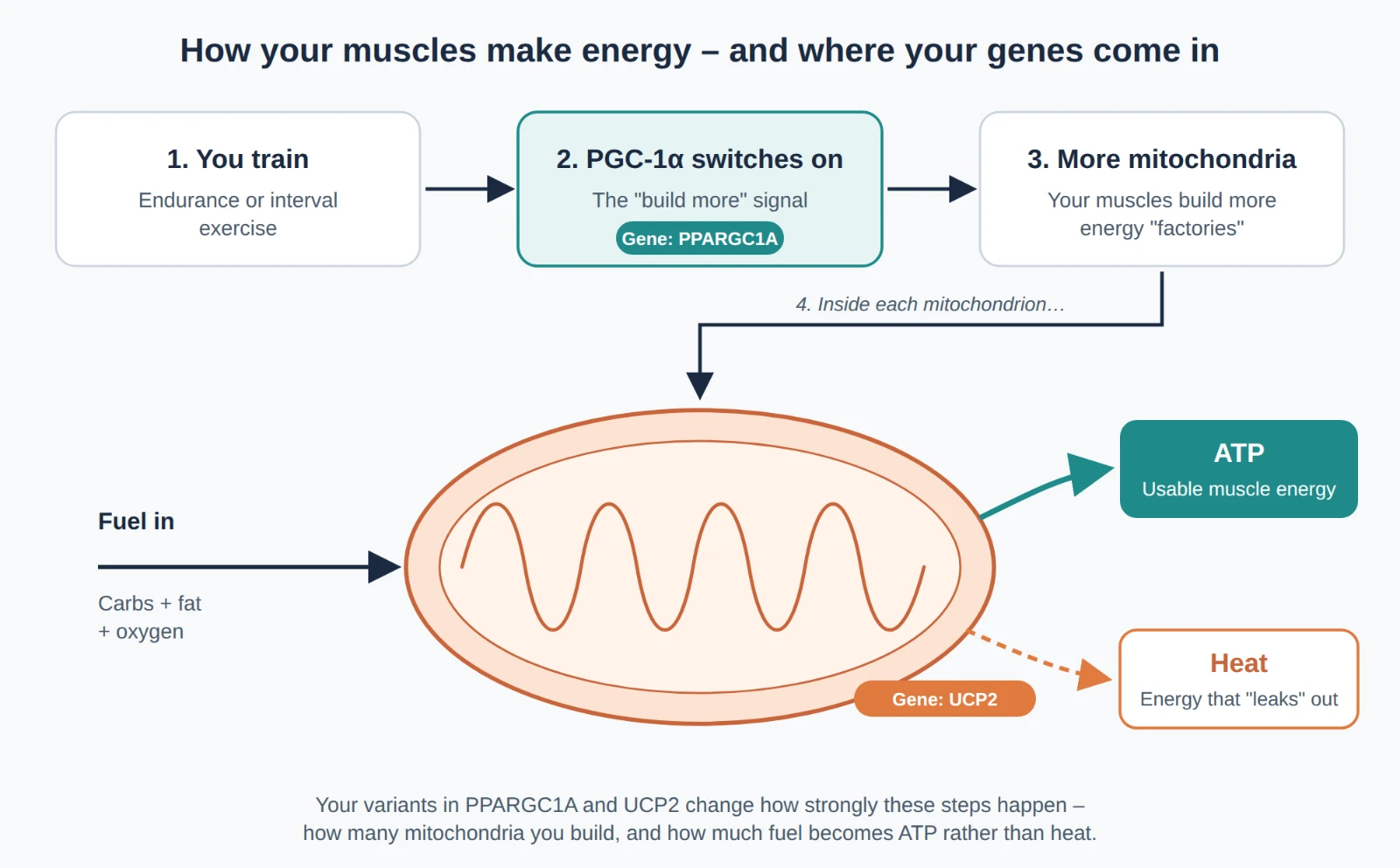
Your muscles run on energy made inside tiny structures called mitochondria, and your genes influence how many mitochondria you build and how efficiently they work. Two genes play a big part. PPARGC1A makes PGC-1α, the protein that tells your muscles to build more mitochondria when you train. UCP2 affects how much of the fuel you burn turns into usable energy and how much is lost as heat. Small differences in either gene can change how your body responds to cardio, how you use fuel and how easily you gain weight.
If you already track your training, your macros and your recovery, knowing the way your cells actually produce energy could be an interesting addition.
Where does muscle energy actually come from?
Every muscle contraction runs on a molecule called ATP. Your body makes a small amount of ATP quickly without oxygen, which is what powers sprints and heavy lifts. Most of it, though, is made in the mitochondria, where carbohydrate and fat are burned with oxygen. Skeletal muscle mitochondria handle most of the body's energy metabolism (Halling & Pilegaard, 2020), so the number of mitochondria you have and how well they work has a direct effect on your stamina, your recovery between sets and how well you burn fat for fuel.
Mitochondria can adapt. Train regularly and your muscles build more of them. Stop training and you lose them. How much you gain, and how quickly, can be influenced by your genes.
What is PGC-1α and why is it called the "master regulator"?
PGC-1α is made from the PPARGC1A gene. It acts as a switch: when you exercise, especially with endurance or interval work, PGC-1α turns on the genes your muscles need to build new mitochondria, burn more fat and resist fatigue. A 2025 meta-analysis of randomised trials found PGC-1α was the most consistently reported marker of mitochondrial growth after exercise. Endurance training caused a large increase in its levels, and interval and steady-state training worked about equally well (Abrego-Guandique et al., 2025).
PGC-1α does more than build mitochondria. It also helps manage mitochondrial quality by clearing out damaged ones and supporting antioxidant defences, and it is linked to how well your muscles respond to insulin (Halling & Pilegaard, 2020). Researchers now think other proteins share this job, so PGC-1α is best seen as a key player rather than the only one (Islam et al., 2020).
How does the PPARGC1A gene vary between people?
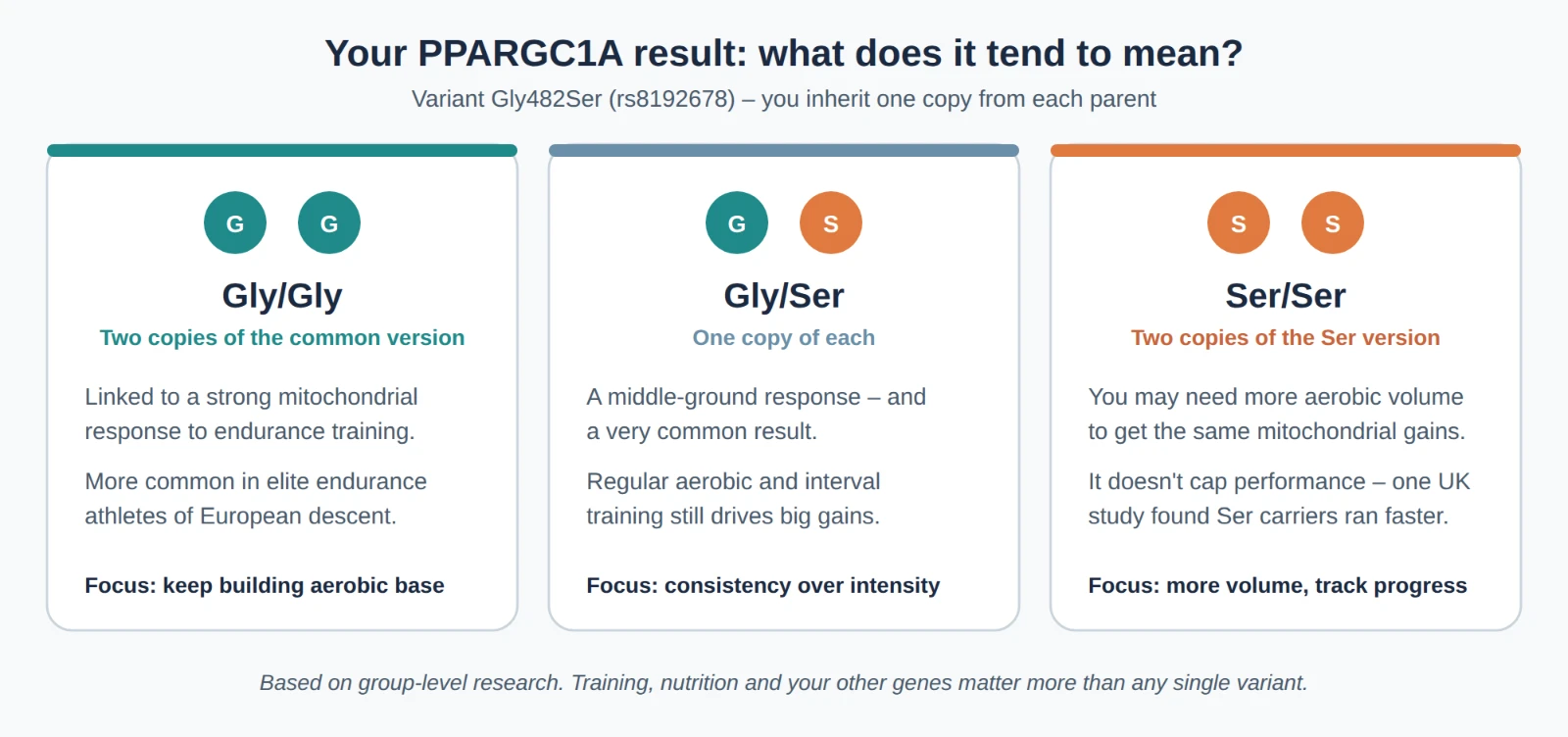
The best-studied variant is called Gly482Ser (rs8192678). You inherit one copy from each parent, so you can be Gly/Gly, Gly/Ser or Ser/Ser. The Ser version is thought to make PGC-1α work a little less effectively.
Studies of elite athletes back this up:
- Among world-class Spanish endurance athletes, 29.1% carried the Ser allele, compared with 40% of unfit controls (Lucia et al., 2005).
- Polish and Russian athletes showed the same pattern: the Ser allele was less common in endurance and strength-endurance athletes (Maciejewska et al., 2012).
- A 2026 meta-analysis of 21 studies (5,795 athletes and 9,048 controls) found Caucasian endurance athletes were about 19% more likely to be Gly/Gly than non-athletes (Su et al., 2026).
The picture isn't completely clear. In UK long-distance runners, Ser carriers were actually 2.5% faster than Gly/Gly runners (Hall et al., 2023), and the meta-analysis found no link in Asian endurance athletes (Su et al., 2026). A single variant doesn't decide your ceiling. It affects how your body tends to respond, and training still does the heavy lifting.
What does UCP2 do in your muscles?
UCP2 makes an "uncoupling protein". Normally, burning fuel in your mitochondria is tightly linked to making ATP. Uncoupling proteins loosen that link a little, so some energy escapes as heat instead of becoming ATP (Sierra-Ruelas et al., 2025). That might sound wasteful, but it is useful: it helps control harmful by-products of energy production (reactive oxygen species) and affects how many calories you burn at rest.
Because of this, UCP2 variants are linked to both endurance and body composition:
- Endurance: In elite Polish half marathoners, 84.2% of runners finishing under 100 minutes carried the UCP2 Val allele (Ala55Val, rs660339), compared with 55.8% of slower runners (Gronek et al., 2018).
- Weight gain: In a two-year study, people with the GG genotype of another UCP2 variant (-866G/A) gained more weight and body fat when they ate more, while other genotypes were less affected (Muhammad et al., 2021).
- Abdominal fat: In women with an unhealthy metabolic profile, the Ala55Val variant was linked to roughly three times the risk of abdominal obesity (Sierra-Ruelas et al., 2025).
So the same gene can affect how efficiently you run and how your body stores extra calories. It works less like a "good" or "bad" gene and more like a setting that suits some goals better than others.
Do PGC-1α and UCP2 work together?
Yes. PGC-1α decides how much energy-producing machinery your muscles build, and UCP2 affects how efficiently that machinery turns fuel into ATP. Endurance performance also seems to depend on many genes adding up: half marathoners with a high number of "endurance" alleles across ACE, NOS3, BDKRB2 and UCP2 were far more likely to be in the fastest group (Gronek et al., 2018). In Israeli athletes, a combination of PPARGC1A Gly/Gly with a PPARD variant was about eight times more likely in elite endurance athletes than in national-level ones (Eynon et al., 2009). No single gene decides your energy system. Your combined profile gives a better picture.
What should you do differently based on your genes?
Your genes don't change what works. They change how much of it you might need and where to focus.
- If your PPARGC1A profile suggests a lower mitochondrial response: give priority to regular aerobic and interval training, because both reliably increase PGC-1α. You may need more consistency or volume to see the same aerobic gains as someone else.
- If your UCP2 profile suggests a lower resting burn or weight gain when you overeat: keep a closer eye on calorie surpluses, especially during a bulk, and keep regular cardio in your week.
- For everyone: mixing endurance and resistance training supports mitochondrial health, and sleep and recovery matter because these adaptations happen between sessions, not during them.
Want to know your own PPARGC1A and UCP2 results?
Get your FitnessGenes DNA test here
FAQs
What are mitochondria?
Mitochondria (often referred to as the powerhouse of the cells) are structures inside your cells that turn food and oxygen into ATP, the energy your muscles use to contract. Muscle cells contain a lot of them, and endurance training increases how many you have.
Can you increase PGC-1α naturally?
Yes. Endurance and high-intensity interval training are the most reliable ways to raise PGC-1α in muscle, and they appear to work about equally well (Abrego-Guandique et al., 2025).
Does having the PPARGC1A Ser allele mean I can't be good at endurance sport?
No. The Ser allele is less common in some elite endurance groups, but one study of UK distance runners found Ser carriers ran faster (Hall et al., 2023). Training, nutrition and many other genes matter far more than any single variant.
Is UCP2 linked to metabolism and weight?
Yes. Because UCP2 affects how much energy is released as heat rather than stored as ATP, its variants have been linked to resting energy use, weight gain when overeating and abdominal fat (Muhammad et al., 2021; Sierra-Ruelas et al., 2025).
Should I choose my sport based on these genes?
Probably not. These genes can help you understand why you respond the way you do and how to adjust your training, but they can't predict what you're capable of. Enjoying your sport and sticking with it still matter most.
How can I find out my PPARGC1A and UCP2 genotype?
A DNA test that includes fitness and metabolism genes, such as the FitnessGenes DNA analysis, can report your variants alongside training and nutrition advice based on them.
References
Abrego-Guandique DM, Aguilera Rojas NM, Chiari A, Luciani F, Cione E, Cannataro R. (2025). The impact of exercise on mitochondrial biogenesis in skeletal muscle: a systematic review and meta-analysis of randomized trials. *Biomolecular Concepts*, 16(1). https://doi.org/10.1515/bmc-2025-0055
Eynon N, Meckel Y, Alves AJ, et al. (2009). Is there an interaction between PPARD T294C and PPARGC1A Gly482Ser polymorphisms and human endurance performance? *Experimental Physiology*, 94(11), 1147-1152. https://doi.org/10.1113/expphysiol.2009.049668
Gronek P, Gronek J, Lulińska-Kuklik E, et al. (2018). Polygenic study of endurance-associated genetic markers NOS3 (Glu298Asp), BDKRB2 (-9/+9), UCP2 (Ala55Val), AMPD1 (Gln45Ter) and ACE (I/D) in Polish male half marathoners. *Journal of Human Kinetics*, 64, 87-98. https://doi.org/10.1515/hukin-2017-0204
Hall ECR, Lockey SJ, Heffernan SM, et al. (2023). The PPARGC1A Gly482Ser polymorphism is associated with elite long-distance running performance. *Journal of Sports Sciences*, 41(1), 56-62. https://doi.org/10.1080/02640414.2023.2195737
Halling JF, Pilegaard H. (2020). PGC-1α-mediated regulation of mitochondrial function and physiological implications. *Applied Physiology, Nutrition, and Metabolism*, 45(9), 927-936. https://doi.org/10.1139/apnm-2020-0005
Islam H, Hood DA, Gurd BJ. (2020). Looking beyond PGC-1α: emerging regulators of exercise-induced skeletal muscle mitochondrial biogenesis and their activation by dietary compounds. *Applied Physiology, Nutrition, and Metabolism*, 45(1), 11-23. https://doi.org/10.1139/apnm-2019-0069
Lucia A, Gómez-Gallego F, Barroso I, et al. (2005). PPARGC1A genotype (Gly482Ser) predicts exceptional endurance capacity in European men. *Journal of Applied Physiology*, 99(1), 344-348. https://doi.org/10.1152/japplphysiol.00037.2005
Maciejewska A, Sawczuk M, Cieszczyk P, Mozhayskaya IA, Ahmetov II. (2012). The PPARGC1A gene Gly482Ser in Polish and Russian athletes. *Journal of Sports Sciences*, 30(1), 101-113. https://doi.org/10.1080/02640414.2011.623709
Muhammad HFL, Sulistyoningrum DC, Huriyati E, Lee YY, Muda WAMW. (2021). The interaction between energy intake, physical activity and UCP2 -866G/A gene variation on weight gain and changes in adiposity: an Indonesian Nutrigenetic Cohort (INDOGENIC). *British Journal of Nutrition*, 125(6), 611-617. https://doi.org/10.1017/S0007114520003104
Sierra-Ruelas E, Torres-Castillo N, Vizmanos B, Pérez WC, Martínez-López E. (2025). Uncoupling proteins variants are linked to hypercholesterolemia and abdominal obesity in metabolically unhealthy women. *Lifestyle Genomics*, 18(1), 27-35. https://doi.org/10.1159/000543484
Su W, Yuan L, He Z, et al. (2026). Association between the PPARGC1A Gly482Ser (rs8192678) polymorphism and endurance and power athlete status: a systematic review and meta-analysis. *Frontiers in Physiology*, 16, 1733458. https://doi.org/10.3389/fphys.2025.1733458