Of everyone who's taken a FitnessGenes DNA analysis, 68% get omega-3 returned as their highest-priority supplement recommendation. It's the most common result we see, by some distance.
A big part of the reason is a set of genes called FADS1, FADS2, and ELOVL2. They govern how efficiently your body converts plant-based omega-3 - the ALA in flaxseed, chia and walnuts - into EPA and DHA, the forms your body actually uses. They also impact your omega-6 levels. Carry the lower-efficiency variants and that conversion runs at a trickle, which means the plant sources you've been relying on may be doing considerably less than the label implies.
But here's an addition to compliment a DNA test, ours included: genes tell you about tendencies, not your current state. A gene result tells you you're likely to run low on EPA and DHA, and also the health risks they may be associated with. It can't tell you whether you are low right now, how far off you are, or whether the fish oil capsule you've taken every morning for two years has moved the needle at all.
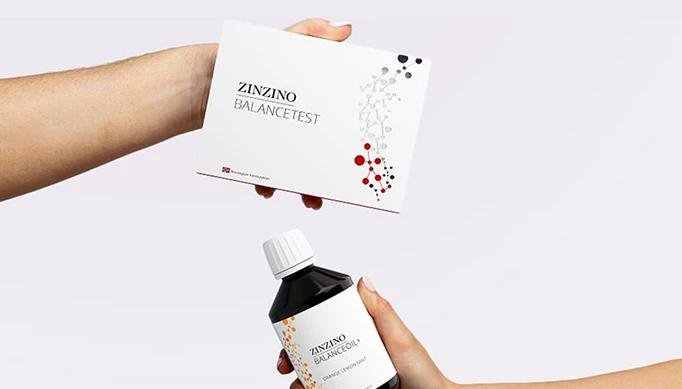
Only a blood test answers that, which is where Zinzino's BalanceTest comes in. Now it’s at this point we’re legally mandated to explain that as a Zinzino Independent Partner, FitnessGenes receive a small commission on orders placed through our website, and this data can further enrich your personal BASIL longevity platform.
Why is omega-3 and omega-6 so important?
Both are essential fats you have to get from food, and they do more than supply energy: they sit in your cell membranes and act as raw material for signalling molecules, with omega-6-derived ones tending to drive inflammation and clotting while omega-3-derived ones help resolve it. Because the two compete for the same enzymes and membrane space, absolute levels and their proportion both matter.
The best-studied marker is the omega-3 index (EPA+DHA as a percentage of red blood cell fatty acids), where under about 4% tracks with substantially higher cardiovascular and all-cause mortality risk and above 8% with the lowest, while typical Western diets run an omega-6:omega-3 ratio nearer 15:1 than the 1–4:1 humans evolved on. Knowing your numbers is useful because this is a risk factor that's independent of cholesterol and fully modifiable. Worth noting the ratio itself is contested; most evidence suggests raising omega-3 matters more than cutting omega-6.
Why the test tells you more than your omega score
Your fatty acid profile provides more than just an omega number; it captures the state of the raw materials your body uses to build cell membranes and signalling molecules. This is why it reflects multiple systems simultaneously. A low omega-3 index and an imbalanced omega-6:omega-3 ratio are linked to cardiovascular risk factors such as inflammation, triglycerides, and clotting. DHA, a key component of brain and retinal membranes, offers insights into cognitive ageing and neurological health.
The combination of the FitnessGenes and Zinzino Omega is particularly effective: your genes reveal how efficiently you convert, transport, and utilise these fats, while the blood test shows what is currently present. This information then informs your broader health profile built out in BASIL. Relying on only one leaves gaps, making both tests valuable. Their results are integrated into your BASIL longevity profile, allowing genetic and real-time data to inform your longevity forecasts and personalised recommendations.
Facts about the test:
What is the Zinzino BalanceTest?
The BalanceTest is a dried blood spot test that measures the fatty acids in your blood. You do the sample collection at home; the analysis happens in a lab.
The reason it exists is simple: omega-3 status is invisible. You can't feel your omega-3 index. You can't infer it reliably from your diet, because absorption and dose response vary a lot between individuals. Two people eating the same meals can land in quite different places. The only way to know is to measure.
How it works:
- Order a kit and it arrives in the post.
- Prick a finger and blot a few drops of blood onto the collection card.
- Post the card back in the pre-paid envelope.
- Get a personalised report, typically within a few weeks.
The whole collection process takes about five minutes and doesn't involve a clinic, an appointment, or a vial of blood.
Who actually analyses it?
Samples are analysed by VITAS Analytical Services, an independent laboratory based at Oslo Science Park in Norway. Zinzino doesn't test your blood in-house. VITAS is a specialist analytical lab that does fatty acid work for research groups and other clients, and it operates to recognised laboratory quality standards.
Most supplement companies never let you verify anything. This one hands the measurement to a third party.
What the test measures
Your report covers a panel of fatty acids and highlights a few key numbers:
Omega-3 index. EPA and DHA expressed as a percentage of your total fatty acids. This is the number to pay attention to. It was developed by researchers Bill Harris and Clemens von Schacky and it's used in published research — it isn't a wellness-industry invention. Under about 4% is generally described as undesirable; 8% or above is the widely cited target zone.
Omega-6 to omega-3 ratio. How much omega-6 you're carrying relative to omega-3. Zinzino works to a target of 3:1 or lower.
AA:EPA ratio. Arachidonic acid relative to EPA.
Supporting values. Saturated fat, trans fat, and other markers that give context to the main results.
A note on the ratio, because you'll see it debated: some researchers focus on the ratio, others argue the absolute omega-3 index is the more meaningful figure. It's a live discussion - but this is something we future contextualise in terms of you other genetic data at FitnessGenes. The practical takeaway is the same either way — both point toward getting more EPA and DHA in, and the test gives you both numbers, so you can watch whichever you find more useful.
What most people's results look like
Expect to be further from the target than you'd guess.
Typical Western diets produce omega-6 to omega-3 ratios somewhere around 10:1 to 20:1. That isn't a personal failing - it reflects how much seed oil, grain-fed meat and processed food is in the average shop, and how little oily fish most people eat. Most people who take the test come back well outside the target range, including people who consider their diet pretty good.
We'd rather tell you that up front than have you open the report and panic. A result outside the target range is the norm, not an emergency. It's a starting point.
The bit that makes testing worth it: the retest
Here's what separates this from most of the supplement industry.
Take a supplement, and normally you have no idea whether it did anything. You take it on faith for years. With a fatty acid test you get a baseline, you change something, and then you measure again — usually after around four months, which is roughly how long it takes for red blood cell membranes to reflect a sustained dietary change.
Then you know. Either the number moved or it didn't.
That closed loop is genuinely useful, and it's the honest reason to test rather than just start taking capsules. It also tends to be what makes the habit stick — people who can see a number move keep going, and people taking something invisible on faith tend to drift.
Who should take the test
Testing makes clear sense if:
- You rarely or never eat oily fish. Most public health guidance suggests two portions a week. Plenty of people manage two portions a year.
- You're vegan or vegetarian. Dietary EPA and DHA intake tends to be low on plant-based diets, and a test tells you whether your algae oil is doing the job.
- You already take a fish oil. This is the group we'd push hardest toward testing. Cheap fish oil can oxidise, doses vary wildly, and "1000mg fish oil" on a label often means far less actual EPA and DHA. Testing tells you whether you're getting value from it.
- You're data-driven. If a concrete before-and-after is what makes you follow through, that's a perfectly good reason.
- You're making changes and want to track them. A baseline is only useful if you take it before you start.
Who can skip it
We'd rather say this than sell a test to someone who doesn't need one:
- You have already recently taken a similar test. You likely already have a good idea of your own omega-3 status.
- You have no intention of acting on the result. A number you ignore is a number you don't need.
- You'd rather just start. Some people don't want the data, they want the habit. Eating more oily fish or taking a well-dosed EPA/DHA supplement is sound regardless of whether you ever test.
What happens after your results
The report gives you your numbers against the target ranges, and the standard next step is raising your EPA and DHA intake — through diet, through supplementation, or both.
On the nutrition side, the officially authorised statements for EPA and DHA are worth knowing, because they're the claims that are actually substantiated:
- EPA and DHA contribute to the normal function of the heart (250mg daily)
- DHA contributes to the maintenance of normal brain function (250mg daily)
- DHA contributes to the maintenance of normal vision (250mg daily)
Your results don't just sit in a report: they feed into BASIL, our longevity platform, alongside your genetics and lifestyle data. That means every test you take sharpens the picture FitnessGenes has of you, so the predictions we make about your longevity needs, and the recommendations that follow, get more accurate rather than staying generic.
Zinzino's own product in this space is BalanceOil, a fish oil blended with polyphenol-rich olive oil, taken daily and dosed to body weight. Retest after four months and you'll see where you've landed, and BASIL will update with it. You don't have to use BalanceOil to change your numbers; more oily fish or another well-dosed EPA/DHA supplement will move them too. But if you want the test and the product from one place, with a retest built into the process.
Ready to test?
For an absolute measure of your current Omega 3 Index & omega-6:3 ratio, a blood test is required. Test your omega-6:3 balance with a Zinzino blood test now.
Questions before you order? Get in touch.
Frequently asked questions
Is the Zinzino balance test accurate?
The analysis is carried out by VITAS Analytical Services, an independent laboratory in Norway, and dried blood spot fatty acid testing is a well-validated collection method used in research. The main thing that affects accuracy is your own sample collection — follow the instructions on the card and let the spots dry properly before posting.
Is Zinzino legitimate?
Yes. Zinzino is a publicly listed company that sells through FitnessGenes, a science led market leader in genetic science and longevity.
How much does the Zinzino BalanceTest cost?
£163.
How long do results take?
Typically a few weeks, since samples are posted to Norway for analysis.
Does it hurt?
It's a single finger prick with a lancet, similar to a diabetes blood glucose check. Most people find it a non-event.
What's a good omega-3 index?
Below roughly 4% is generally described as undesirable and 8% or above as the target zone, following the framework developed by Harris and von Schacky. Most people on a typical Western diet land somewhere in the 4–6% range.
Can my doctor test my omega-3 levels instead?
Usually not as a routine request — omega-3 index testing isn't part of standard primary care panels without a specific clinical reason. Private testing is generally the practical route.
When should I retest?
Around four months after making a change. That's roughly how long red blood cell membranes take to reflect a sustained shift in intake, so testing sooner tends to understate your progress.