
Everyone's talking about it
If you listen to health podcasts, you've probably heard the phrase "Mendelian randomisation". Longevity physician Peter Attia uses it to explain why lifelong LDL cholesterol matters. Rhonda Patrick cites it on vitamin D and dementia. Layne Norton credits it with changing his mind about saturated fat.
It has become a central argument among fitness and longevity influencers to prove that their recommendation, whether in interpreting a disease cause or an intervention, is ‘backed by science’.
However, few listeners could explain what it is. So here is a guide to help.
Mendelian randomisation (MR) uses the genes you were born with as a natural experiment to test whether something really causes or reduces disease.
But why do we need this natural experiment?
The problem: correlation isn't causation
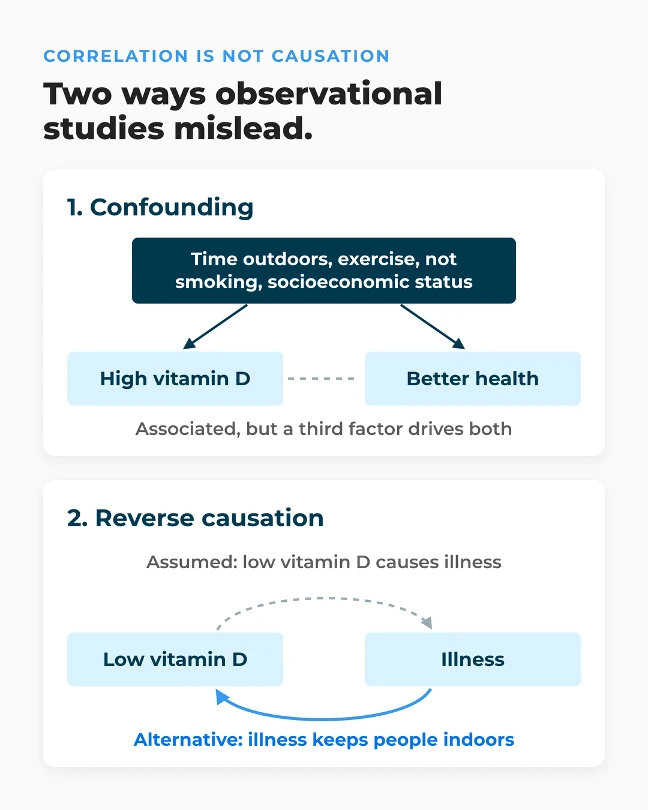
Most health headlines come from observational studies: researchers measure something, such as a blood level or a habit, and see who later gets ill. These studies are fast and cheap but easily fooled in two ways.
- Confounding. People with high vitamin D tend to spend more time outdoors, exercise more and smoke less. Good food and supplement choices also correlate with socioeconomic status. Any of those could explain their better health. ‘Good’ Vitamin D levels are just a marker for these more holistic disease-reducing behaviours – and it can be these, not Vitamin D levels per se, that cause the disease.
- Reverse causation. Illness keeps people indoors, so low vitamin D can result from being unwell rather than cause it.
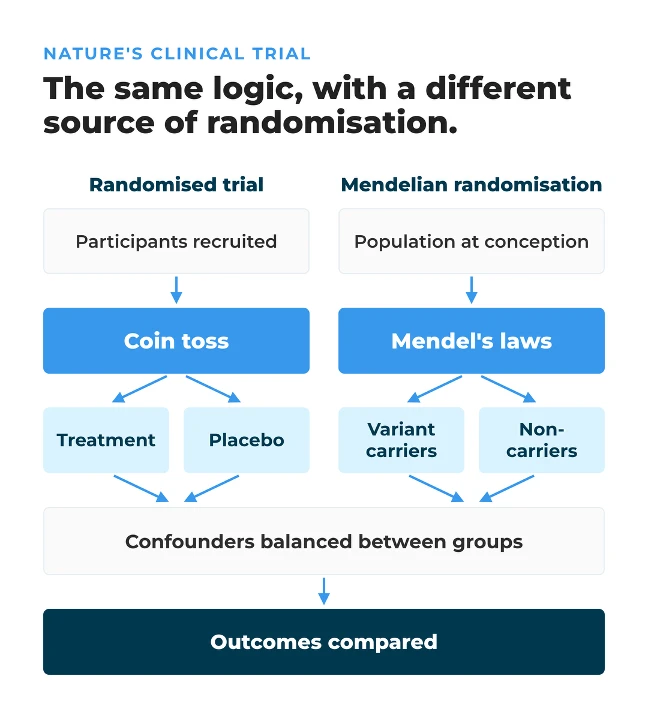
The idea: genes as nature's clinical trial
At conception, you inherit one copy of each gene from each parent, essentially at random. This is Mendel's law of segregation, and it gives the method its name [1].
Some common gene variants (a variant is a small difference in the DNA code at one spot in a gene, shared by many people) slightly raise or lower things like cholesterol, vitamin D or body weight, for life. Because those variants are handed out randomly, carriers and non-carriers are otherwise alike. Your genes don't change when you take up running, and getting ill can't rewrite your DNA.
So the logic is simple. If low vitamin D causes a disease, people born with vitamin D-lowering variants should get that disease slightly more often. If they don't, the observational link was probably driven by something else.
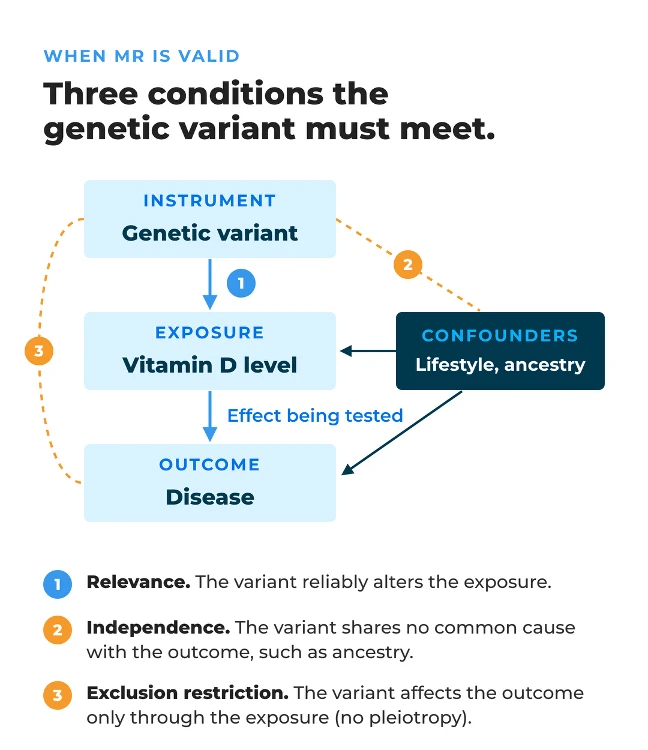
MR only works if the variant meets three conditions [1]. Using vitamin D as the example:
- It must genuinely affect the exposure. The variant has to measurably change vitamin D levels. Variants in GC, for instance, reliably lower blood vitamin D. A variant with only a tiny or uncertain effect gives weak, unreliable answers.
- Nothing else can link the variant to the disease. The main risk here is ancestry. How common a variant is differs between populations, and so do disease rates, for reasons such as diet, climate or healthcare. If a vitamin D-lowering variant is more common in a group that also happens to have more of a disease, the two will look linked even if vitamin D plays no part. Researchers reduce this by studying people of similar ancestry and adjusting for genetic background.
- It must affect the disease only through the exposure. Suppose a “vitamin D” variant also increases body fat, which raises the risk of many diseases. Carriers would get ill more often, but because of the extra fat, not the lower vitamin D. This problem, called pleiotropy, is the main weakness of most MR studies.
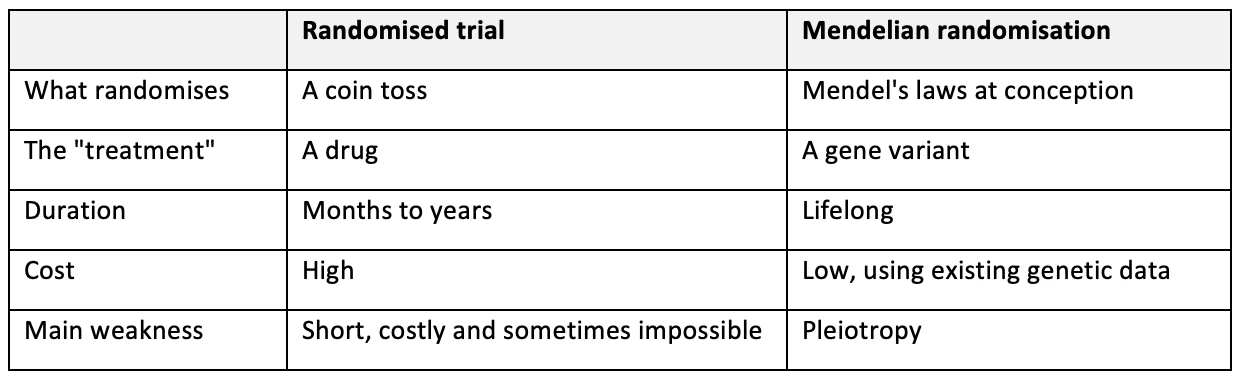
Why not just run a trial? Trials are expensive: VITAL enrolled 25,871 people [2], FOURIER 27,564 [7], and a planned US alcohol trial was budgeted at around $100 million [1]. They are short, usually two to five years, while heart disease, cancer and dementia develop over decades. And many can’t be done at all: it is unethical to randomise people to smoke, drink heavily or gain weight, and traits like height or childhood weight can’t be assigned [1]. MR fills these gaps.
Testing a health claim – vitamin D
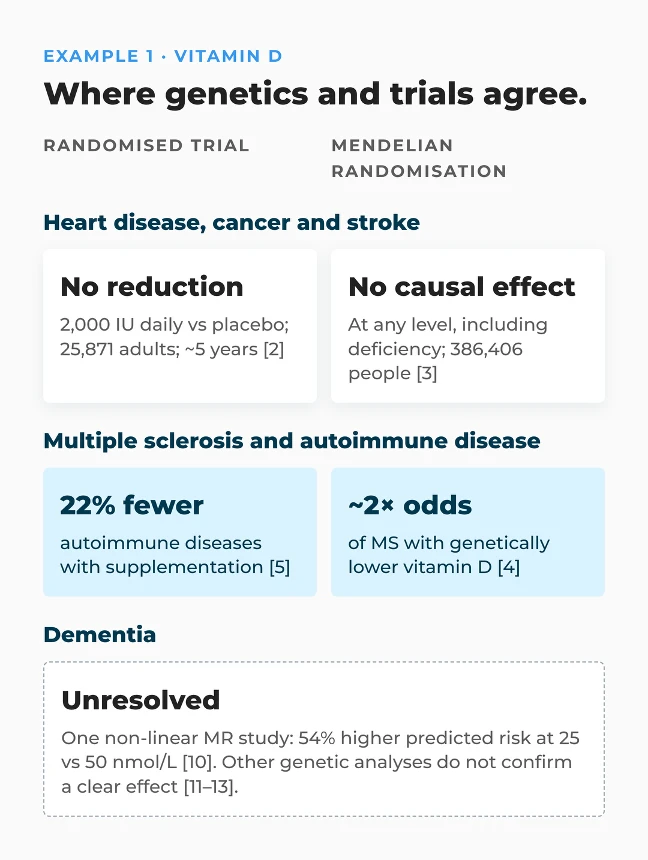
For years, observational studies linked low vitamin D to heart disease, cancer and early death. Then the trials came in. VITAL gave 25,871 adults 2,000 IU daily or placebo for about five years and found no reduction in cancer or cardiovascular events [2].
Sceptics argued the trials enrolled people who weren't deficient. MR could test that. Vitamin D MR studies typically use common variants in four genes that control how the body makes and handles vitamin D: DHCR7 (production in the skin), CYP2R1 (activation in the liver), GC (the protein that carries vitamin D in the blood) and CYP24A1 (breakdown) [4]. A study of 386,406 people found no causal effect of vitamin D on heart disease, stroke or death at any level, including deficiency [3]. Interestingly, an earlier version of this study reported the opposite. It was retracted after its statistical method was shown to be flawed, a reminder that MR is only as good as its methods [3].
One finding stands out. A 2015 MR study using variants in these four genes found that genetically lower vitamin D roughly doubled the odds of multiple sclerosis [4]. VITAL later found supplements cut autoimmune disease by about 22% [5], and a 2025 trial found high-dose vitamin D reduced disease activity in early MS [15]. Where genetics and trials agree, confidence grows. Genetics also provides a useful indication of where the next trial should be conducted.
The evidence on dementia is less clear. A 2022 UK Biobank study using non-linear MR (a version of MR that estimates the effect separately at different vitamin D levels, rather than assuming each extra unit has the same effect, so it can test whether only deficient people are affected) found that people at 25 nmol/L of vitamin D had a 54% higher predicted risk of dementia than those at 50 nmol/L [10]. But it used a non-linear approach similar to the one behind the retracted mortality paper, and other genetic studies disagree. An earlier signal for Alzheimer’s disease [11] rested largely on a single GC variant, hinting at pleiotropy [12], and updated analyses found no clear effect [13, 16]. Severe deficiency may matter for dementia, but this result needs confirming before it is treated as settled.
Validating a drug target – PCSK9
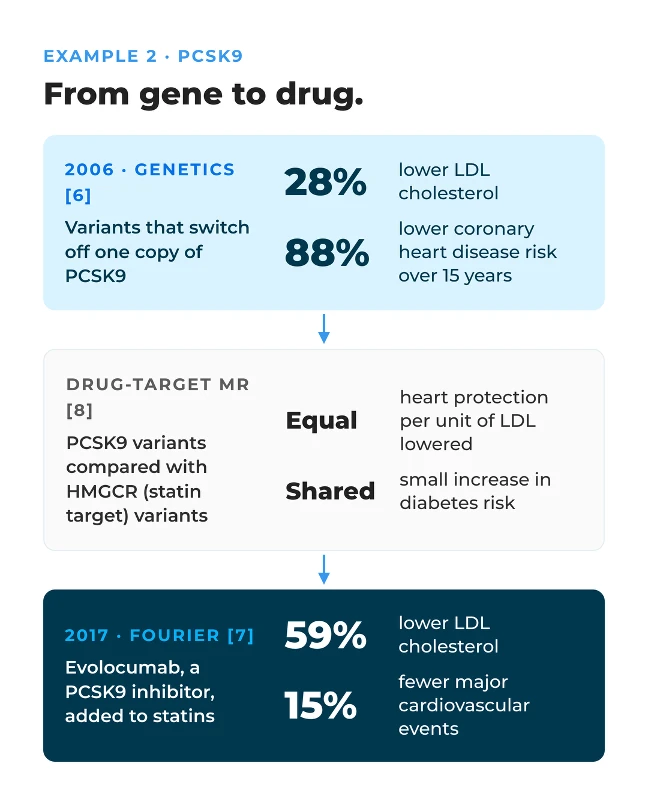
The PCSK9 protein reduces the liver's ability to clear LDL cholesterol from the blood. In 2006, researchers found that people born with variants that switch off one copy of the PCSK9 gene had 28% lower LDL and an 88% lower risk of coronary heart disease over 15 years [6]. A modest reduction, sustained from birth, had an outsized effect.
That discovery launched research into finding PCSK9-blocking drugs. In the FOURIER trial, evolocumab cut LDL by 59% and major cardiovascular events by 15% in people already on statins [7]. In 2025, VESALIUS-CV showed it also cuts first heart attacks and strokes, by 25% [14].
MR also helped predict how these drugs would behave. Comparing variants in PCSK9 with variants in HMGCR, the gene targeted by statins, showed both gave the same heart protection per unit of LDL lowered. Both also carried a small increase in diabetes risk, a possible side effect worth watching [8].
This approach, called drug-target MR, is now routine in drug development. Drug programmes backed by human genetic evidence are about 2.6 times more likely to reach approval [9].
What MR can't do
MR shows whether a target or exposure matters. It doesn’t prove a drug works or whether it has side effects. Genes act lifelong with small effects (but as we have seen these small effects can cause big changes over many decades), while treatments act strongly for a few years, often after disease has begun [1]. Most MR also looks at who develops a disease, not what helps once you have it.
Other pitfalls include pleiotropy, population structure, biobank volunteers who are healthier than average, and genetic data drawn mostly from people of European ancestry [1]. Because two-sample MR is now quick to run on public data, low-quality studies are common.
When you next hear an MR claim on a podcast, ask three questions:
- Is there a clear biological link between the gene and the exposure?
- Did the authors test for pleiotropy using several methods?
- Does the result agree with trials and other evidence?
Used carefully, MR is one of the best tools we have for separating cause from coincidence.
References
- Sanderson E, et al. Mendelian randomization. Nature Reviews Methods Primers 2022;2:6. doi:10.1038/s43586-021-00092-5
- Manson JE, et al. Vitamin D supplements and prevention of cancer and cardiovascular disease (VITAL). NEJM2019;380:33–44. summary
- Emerging Risk Factors Collaboration/EPIC-CVD/Vitamin D Studies Collaboration. Dose–response relationships for vitamin D: observational and revised Mendelian randomisation analyses. Lancet Diabetes & Endocrinology 2024;12:e2–e11. link; retraction notice
- Mokry LE, et al. Vitamin D and risk of multiple sclerosis: a Mendelian randomization study. PLoS Medicine2015;12:e1001866. doi:10.1371/journal.pmed.1001866
- Hahn J, et al. Vitamin D and marine omega 3 supplementation and incident autoimmune disease: VITAL. BMJ2022;376:e066452. link
- Cohen JC, et al. Sequence variations in PCSK9, low LDL, and protection against coronary heart disease. NEJM 2006;354:1264–1272. doi:10.1056/NEJMoa054013
- Sabatine MS, et al. Evolocumab and clinical outcomes in patients with cardiovascular disease (FOURIER). NEJM 2017;376:1713–1722. doi:10.1056/NEJMoa1615664
- Ference BA, et al. Variation in PCSK9 and HMGCR and risk of cardiovascular disease and diabetes. NEJM2016;375:2144–2153. doi:10.1056/NEJMoa1604304
- Minikel EV, et al. Refining the impact of genetic evidence on clinical success. Nature 2024;629:624–629. doi:10.1038/s41586-024-07316-0
- Navale SS, et al. Vitamin D and brain health: an observational and Mendelian randomization study. American Journal of Clinical Nutrition 2022;116:531–540. doi:10.1093/ajcn/nqac107
- Mokry LE, et al. Genetically decreased vitamin D and risk of Alzheimer disease. Neurology 2016;87:2567–2574. doi:10.1212/WNL.0000000000003430
- Maddock J, et al. Vitamin D and cognitive function: a Mendelian randomisation study. Scientific Reports 2017. doi:10.1038/s41598-017-13189-3
- Larsson SC, et al. Serum parathyroid hormone, 25-hydroxyvitamin D, and risk of Alzheimer’s disease: a Mendelian randomization study. Nutrients 2018;10:1243. doi:10.3390/nu10091243
- Bohula EA, et al. Evolocumab in patients without prior myocardial infarction or stroke (VESALIUS-CV). NEJM2025. doi:10.1056/NEJMoa2514428
- Thouvenot E, et al. High-dose vitamin D in clinically isolated syndrome typical of multiple sclerosis: the D-Lay MS randomized clinical trial. JAMA 2025;333:1413–1422. doi:10.1001/jama.2025.1604
- Ilboudo Y, et al. Vitamin D, cognition, and Alzheimer’s disease: observational and two-sample Mendelian randomization studies. J Alzheimers Dis 2024;99:1243–1260. doi:10.3233/JAD-221223