For years, the standard advice has been to watch your omega-6 to omega-3 ratio - get it low enough, and you're covered. But a growing body of research points to a different number, the Omega-3 Index, as the far better predictor of your actual health.
The most striking evidence comes from the Framingham Offspring Study, which has followed the same group of people for decades. When researchers looked at where participants sat on the Omega-3 Index, moving from the lowest fifth to the highest was worth an extra 4.74 years of life expectancy. In the same analysis, smoking cost 4.73 years - which puts a low Omega-3 Index on much the same footing as a smoking habit.
So should we scrap the ratio altogether? Here's what the evidence says - including why omega-6 isn't the villain the ratio assumes, and why genetics decides how much omega-3 you need to reach the optimal level in the first place.
What are omega-3 and omega-6 fatty acids?
Omega-3 and omega-6 aren't single fats - they're whole families of fat, a bit like how "citrus fruit" isn't one fruit but a category that covers oranges, lemons, and limes. What puts a fat into one family or the other comes down to a single small structural detail: where its first "kink" sits along the chain. Three carbons in and it's an omega-3; six, and it's an omega-6.
Everything else about how a fat behaves in the body can differ hugely within the family - just as an orange and a lime don't taste alike, despite both being citrus.

Each family has one essential starting fat, one your body cannot make on its own, so it has to come from food. On the omega-6 side, that's linoleic acid (LA), found in seed oils like sunflower, corn, and soybean oil. On the omega-3 side, it's alpha-linolenic acid (ALA), found in flaxseed, walnuts, and leafy greens.
But LA and ALA aren't actually the forms your body uses day to day. It has to convert them into longer, more useful versions: arachidonic acid (AA) from omega-6, and EPA and DHA from omega-3. DHA is especially important - it's a key building block of the brain and eyes.
Which is why "eat more omega-3" is too vague to be useful. The omega-3 in plant sources like flaxseed (ALA) and the omega-3 in salmon and other oily fish (EPA and DHA) are not the same fat, and they don't do the same job.
Two numbers get used to track all this. The omega-6:3 ratio compares how much omega-6 you eat, or have circulating, against how much omega-3, and the lower the number the better, in theory. The Omega-3 Index instead measures EPA and DHA directly, as a share of the fats in your red blood cells. They sound like two ways of asking the same question, but are quite different.
How does the body convert these fats, and why does it matter?
The two starting fats, omega-6 LA and omega-3 ALA, are converted by the same enzymes, which means they are, in effect, competing for the same conversion pathway.
Because LA typically outnumbers ALA in a Western diet by around ten to one, omega-6 tends to dominate this shared conversion route. This is the biological basis for concerns about excess omega-6 crowding out omega-3.
Where the ratio falls apart
In one study, researchers gave people diets with the same LA-to-ALA ratio, but different total amounts of each fat. The ratio stayed identical, but the results flipped: cutting LA improved omega-3 conversion, while raising ALA at that same ratio made it worse. It's the actual amount of fat you eat that matters - not the ratio between them (Goyens et al., 2006).
Dr William Harris, the scientist behind the Omega-3 Index, has argued that the ratio itself is a flawed and “meaningless” health metric, as the same ratio can result from very different situations.
Start at 4:1. Halving your omega-6 intake, or doubling your omega-3 intake can both give you the same "2:1" number, even though they mean very different things for your body (Harris, 2006).
What the evidence does support is that we're simply eating a lot more omega-6 LA than we used to, mostly from soybean and other seed oils (Blasbalg et al., 2011). Cutting back on LA can modestly raise EPA levels, though it doesn't do much for DHA specifically - itself a sign that absolute amounts, not ratios, are what actually move the needle.
Is omega-6 even the villain the ratio assumes?
The ratio only makes sense as a target if omega-6 is something to be minimised. It's become common wisdom that omega-6 causes inflammation and heart problems while omega-3 protects against them. But, as ever, the actual research tells a more complicated story.
A large analysis covering tens of thousands of people found that those with more omega-6 LA in their blood had lower rates of heart disease and heart-related death - the opposite of what the "inflammatory omega-6" story predicts. Arachidonic acid (AA), the omega-6 fat most often blamed for inflammation, showed no link to higher risk at all (Marklund et al., 2019). While blood levels aren't a perfect proxy for intake, the direction was the opposite of what might have been expected.
That doesn't mean the amount you eat is irrelevant, but it would suggest that omega-6 isn't simply harmful. It builds cell membranes and supports immune function, and inflammation itself is a normal, necessary process rather than something to eliminate.
Harris and others argue that the villain isn't omega-6 itself, but the foods it usually arrives in. They point out that omega-6 from nuts, seeds and eggs comes with nutrients attached, while omega-6 from deep-fried snacks, fast food and cheap, degraded cooking oils does not, and that those foods are bad for your heart because of what else is in them, not simply because they contain omega-6.
Their conclusion is that rather than working out a ratio or cutting back on nuts, seeds and eggs, two things matter: eating fewer ultra-processed foods, and raising omega-3 through oily fish or a supplement.
How much of this is genetic?
Two genes, FADS1 and FADS2, sit right next to each other in your DNA and are usually inherited as a pair. Variations here have a real, measurable effect on conversion efficiency - but that effect lands almost entirely on the omega-6 side. A "slow" version of these genes mainly means omega-6 raw material builds up rather than converting efficiently; the effect on omega-3 conversion is much smaller by comparison. Whether that also means low omega-3 depends far more on what you eat than on your genes alone (Tanaka et al., 2009).
These genes have an extraordinary history. In 2015, researchers scanned the genomes of 191 Greenlandic Inuit looking for signs that evolution had been at work, and the single strongest signal anywhere in the genome sat right on the FADS genes. One version of the gene is carried by around 98% of Inuit, compared with just 2.5% of Europeans, a striking imbalance for a single variant. The obvious assumption is that the Inuit evolved to handle their famously fish-heavy diet - to process marine omega-3 more efficiently. That isn't what the researchers found. 
The selected gene version was actually linked to lower levels of EPA, not higher, and had no measurable effect on DHA at all. Its biggest measurable effect wasn't on fat levels - it was on height. The likely explanation: when a diet already delivers huge amounts of ready-made omega-3 straight from fish, the body doesn't need its own conversion pathway running at full speed, so evolution seems to have dialled it down, rather than up (Fumagalli et al., 2015).
A separate gene, ELOVL2, governs the specific step required to produce DHA and appears to be more directly actionable. In a 2025 supplementation trial, genetic variation in ELOVL2 - but not FADS1 - predicted how much a person's omega-3 index improved after four weeks of fish oil supplementation (Medoro et al., 2025).
A further gene, APOE, affects a different part of the picture entirely: not production, but clearance. Carriers of the APOE ε4 variant have been shown in tracer studies to break down DHA considerably faster than non-carriers. This suggests that for ε4 carriers, consistent daily intake may matter more than occasional higher doses - though this research is based on small sample sizes and should be treated as a general principle rather than a precise dosing guide.
The oestrogen advantage
Hormones make a difference too. Oestrogen appears to speed up the enzymes that do this conversion work, which is why women of reproductive age tend to convert ALA into DHA more readily than men (Giltay et al., 2004a). It's a sensible piece of design: a developing baby's brain is roughly 60% fat by dry weight, and DHA is one of its main building blocks - a woman capable of pregnancy is, in effect, running a bigger construction project than a man is. That advantage seems to fade after menopause, as oestrogen drops: research on hormone therapy in postmenopausal women found that restoring oestrogen raised DHA and AA levels again, which backs up the idea that oestrogen itself is doing the work, not something else about being female (Giltay et al., 2004b). In practical terms, this means plant sources like flaxseed can raise your ALA levels, but they're a poor way to raise DHA specifically, especially for men and postmenopausal women.
Broadly, your genes and hormones tend to influence how much omega-3 a person needs and how quickly a shortfall develops, rather than changing the fundamental recommendation. That is, for the large majority of people regardless of genotype, to prioritise direct sources of EPA and DHA.
The better number: the Omega-3 Index
As we saw earlier, the most established marker for assessing omega-3 status is the Omega-3 Index, which measures EPA and DHA as a percentage of the fatty acids in red blood cell membranes.
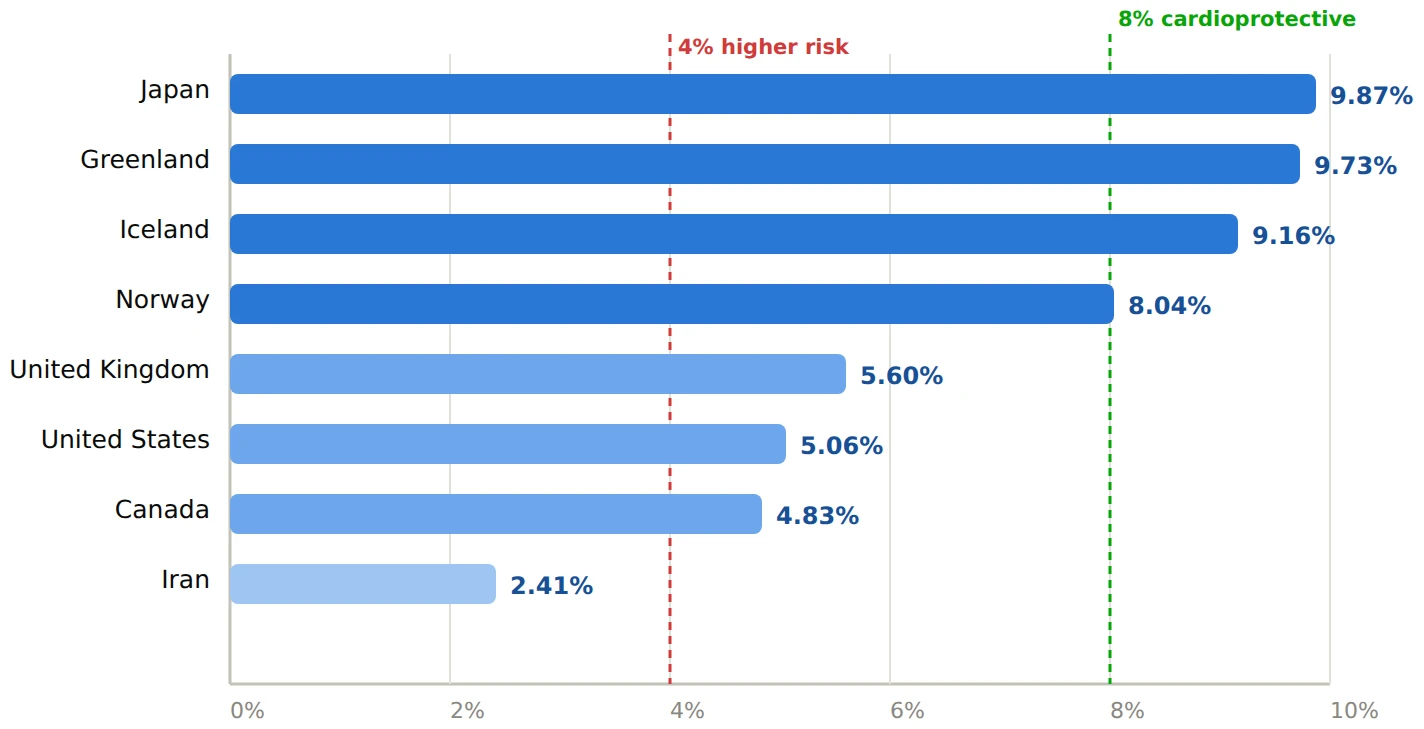
Because red blood cells are replaced roughly every 120 days, the index reflects intake over several months rather than recent meals. A level of 8% or above is generally considered cardioprotective, while 4% or below is associated with higher risk.
Find Out Your Personal Omega-3 Index
Can you reach an 8% Omega-3 Index through diet alone?
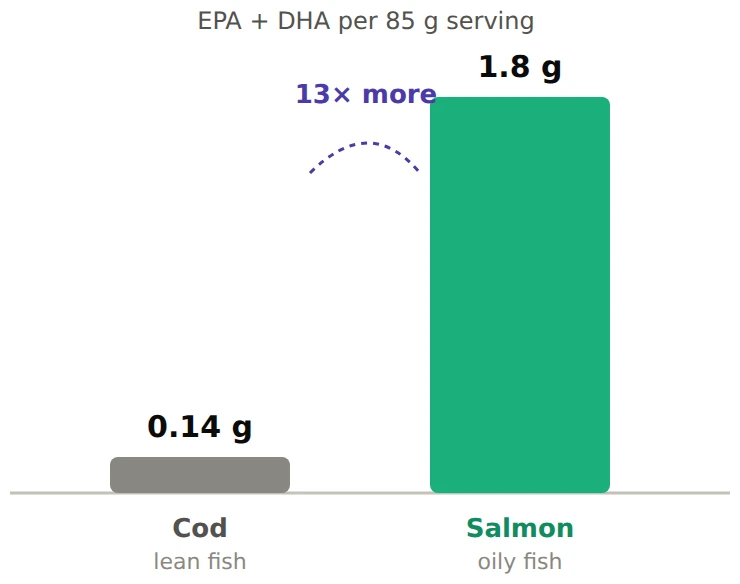
Increasing your omega-3 index through diet alone is achievable but has limits: two servings of oily fish per week typically moves someone from a low to a moderate level, but rarely enables them to reach 8% without supplementation. Fish species also matters considerably more than frequency - an 85g serving of salmon provides roughly thirteen times more combined EPA and DHA than the same serving of cod, since the difference between oily and lean fish is far larger than the difference between farmed and wild.
If you don't eat fish, algae oil is the one plant source that supplies EPA and DHA directly, rather than ALA, which is why it can raise your Omega-3 Index in a way flaxseed cannot. Algae is where fish get their omega-3 in the first place, and trials show algae oil is absorbed about as well as fish oil. Grown in tanks rather than harvested from the sea, it also avoids the mercury, microplastics and PCBs that come with the ocean.
One caveat: whole seaweeds such as nori and kelp contain very little EPA and DHA, so it takes concentrated algae oil rather than a sushi habit to shift your Index.
What does this mean in practice?
- Get EPA and DHA directly, from fish such as salmon, mackerel, sardines and anchovies, or from an algae-based supplement, rather than relying on plant ALA to cover your DHA. This matters more if you are male, or post-menopausal.
- Choose the oily species over the lean one. Which fish you eat affects your omega-3 intake more than how often you eat it.
- Change where your omega-6 comes from, rather than tracking the ratio. Swap sunflower, corn and soybean oil for olive, avocado or rapeseed, and cut fried and ultra-processed food rather than nuts and seeds.
- Supplement rather than trying to convert, if you carry variants associated with slower conversion (FADS1, FADS2, ELOVL2) and don't eat oily fish regularly.
- If you also carry the APOE ε4 variant, consistent daily intake is likely to be more effective than occasional higher doses.
What does FitnessGenes offer?
FitnessGenes' DNA analysis covers fatty acid metabolism, including FADS1, FADS2 and ELOVL2, three of the variants with most influence on how efficiently you convert plant omega-3 into EPA and DHA. Combined with your diet and lifestyle answers through the TrueTrait™ model, your report shows how far you depend on getting EPA and DHA directly from food, and how you can optimise your own Omega-3 Index.
FAQs
I eat fish regularly but my omega-3 index is still low. Why?
Which fish matters more than how often. Lean fish such as cod and tuna contain relatively little EPA and DHA compared with oily fish such as salmon, mackerel and sardines, so switching species usually does more than eating fish more frequently.
How the fish was raised matters too. As salmon farming shifted to feed containing more plant oil, the EPA and DHA in farmed salmon fell substantially, with one analysis of Scottish farmed salmon finding levels roughly halved over a decade. A portion still comfortably beats cod, but it now takes two to supply the EPA and DHA that a single portion did ten years ago.
Should I still try to balance my omega-6 to omega-3 ratio?
While it can be a useful indicator of the quality of your diet, the research suggests the ratio itself isn’t a particularly useful target. Focusing on the absolute amount of omega-3 you eat, and ensuring adequate direct intake of EPA and DHA, is a more evidence-based approach than trying to hit a specific ratio.
Is omega-6 actually bad for me?
Not based on current evidence. Omega-6 performs necessary functions in the body, and higher blood levels of its main derivatives have not been associated with increased cardiovascular risk in large studies. The amount most people consume has increased significantly over the last century, which is worth being aware of, but omega-6 itself isn’t the dietary villain it’s sometimes made out to be.
Can flaxseed or walnuts give me enough DHA?
Not reliably, particularly for men. These foods contain ALA, which the body must convert into DHA, and that conversion is inefficient - in men, research has shown it can be close to negligible. Direct sources of DHA, such as oily fish or algae oil, are a more reliable option.
Does genetics affect my omega-3 levels?
Yes, to a degree. Variants in genes such as FADS1, FADS2, and ELOVL2 affect how efficiently your body converts plant-based omega fats into their usable forms, and APOE affects how quickly DHA is cleared from the body. That said, your genes influence the size of the gap rather than how to close it. That part is the same for everyone: get EPA and DHA from food or a supplement rather than expecting conversion to do all the work.
References
Blasbalg, T. L., Hibbeln, J. R., Ramsden, C. E., Majchrzak, S. F., & Rawlings, R. R. (2011). Changes in consumption of omega-3 and omega-6 fatty acids in the United States during the 20th century. American Journal of Clinical Nutrition, 93(5), 950–962.
Burdge, G. C., & Wootton, S. A. (2002). Conversion of α-linolenic acid to eicosapentaenoic, docosapentaenoic and docosahexaenoic acids in young women. British Journal of Nutrition, 88(4), 411–420.
Giltay, E. J., Gooren, L. J., Toorians, A. W., Katan, M. B., & Zock, P. L. (2004). Docosahexaenoic acid concentrations are higher in women than in men because of estrogenic effects. American Journal of Clinical Nutrition, 80(5), 1167–1174.
Goyens, P. L. L., Spilker, M. E., Zock, P. L., Katan, M. B., & Mensink, R. P. (2006). Conversion of α-linolenic acid in humans is influenced by the absolute amounts of α-linolenic acid and linoleic acid in the diet and not by their ratio. American Journal of Clinical Nutrition, 84(1), 44–53.
Harris, W. S. (2006). The omega-6/omega-3 ratio and cardiovascular disease risk: Uses and abuses. Current Atherosclerosis Reports, 8(6), 453–459.
Marklund, M., Wu, J. H. Y., Imamura, F., et al. (2019). Biomarkers of dietary omega-6 fatty acids and incident cardiovascular disease and mortality. Circulation, 139(21), 2422–2436.
Medoro, A., Graziano, F., Cardinale, G., et al. (2025). The influence of FADS1 and ELOVL2 genetic polymorphisms on polyunsaturated fatty acid composition in response to fish oil supplementation. Lipids in Health and Disease, 24, 97.
Schuchardt, J. P., Beinhorn, P., Harris, W. S., et al. (2024). Omega-3 world map: 2024 update. Progress in Lipid Research, 95.
Tanaka, T., Shen, J., Abecasis, G. R., et al. (2009). Genome-wide association study of plasma polyunsaturated fatty acids in the InCHIANTI study. PLoS Genetics, 5(1), e1000338.