
If you have ever knocked back a double espresso before a training session and wondered why you felt worse, not better, your CYP1A2 genotype may already have the answer.
Your DNA determines whether caffeine is a genuine performance tool or a liability in disguise.
The CYP1A2 gene (rs762551) controls how fast your body clears caffeine, with fast metabolisers (AA genotype) gaining measurable improvements in endurance, strength, and power, while slow metabolisers (CC genotype) may see performance worsen on the same dose. The ADORA2A gene adds a second layer, shaping how sensitive your adenosine receptors are and how likely you are to experience anxiety, jitteriness, or disrupted sleep from caffeine exposure. Together, these two variants explain much of the individual variation in caffeine response that average guidelines cannot account for.
What Is the CYP1A2 Gene and Why Does It Determine Your Caffeine Response?
The CYP1A2 gene encodes cytochrome P450 1A2, a liver enzyme responsible for metabolising more than 95% of the caffeine you consume. A variant of this gene, rs762551, determines how active this enzyme is, and therefore how quickly caffeine is cleared from your bloodstream.
This variant creates three possible genotypes. The AA genotype produces a highly active CYP1A2 enzyme, clearing caffeine rapidly. The CC genotype produces a less active form, leaving caffeine in circulation substantially longer. The AC genotype sits between these two extremes. The half-life of caffeine in fast metabolisers is roughly 2.5–3 hours; in slow metabolisers it can extend to 9–10 hours - meaning a mid-afternoon coffee can still be active in a CC individual's bloodstream at midnight.
How Does the ADORA2A Gene Interact with Caffeine?
Caffeine's primary mechanism of action is blocking adenosine receptors in the brain - specifically the A2A subtype - preventing the build-up of fatigue signals. The ADORA2A gene encodes this receptor, and variants within it determine how sensitively your brain responds to caffeine's blockade. Individuals with certain ADORA2A genotypes experience heightened anxiety and panic-like symptoms even from modest caffeine doses, while others tolerate the same exposure with minimal psychological side effects (Southward et al., 2018). CYP1A2 controls how long caffeine stays in your system; ADORA2A controls what happens when it gets there.
Where CYP1A2 is the primary driver of performance differences, ADORA2A is more closely linked to the psychological and anxiogenic side effects of caffeine, and has also been shown to moderate the association between caffeine and blood pressure and glucose response (Virgili et al., 2023). Testing both variants together provides the most complete picture of your individual caffeine response profile.
How Does Your CYP1A2 Genotype Affect Endurance Performance?
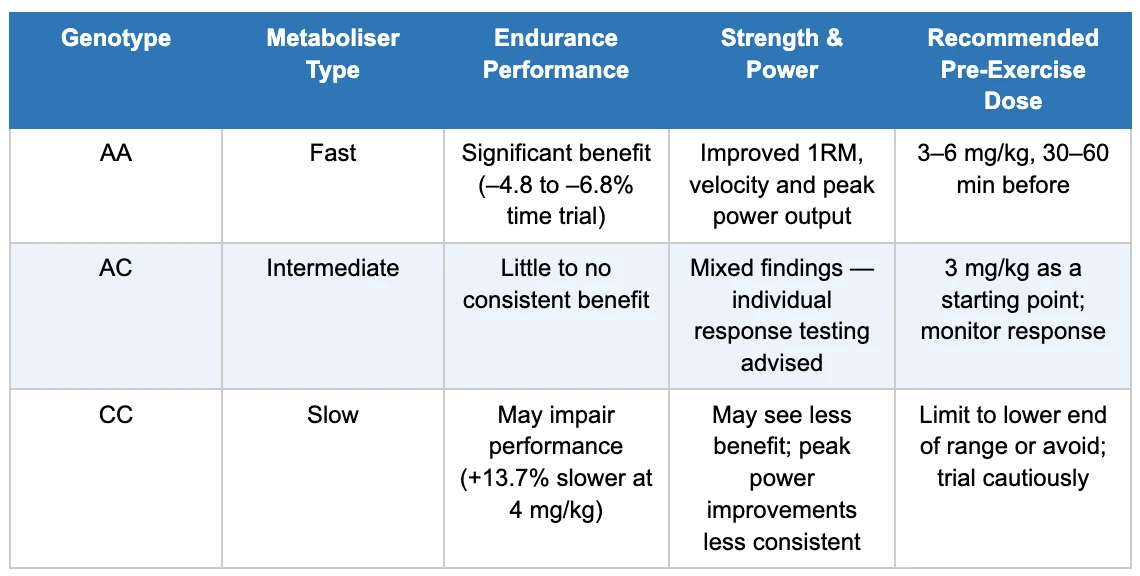
The evidence base for genotype-dependent caffeine effects on endurance is strong and well-replicated. A double-blind, placebo-controlled, randomised trial in 101 competitive male cyclists showed that at 4 mg/kg body weight, caffeine cut 10-km time trial completion time by 6.8% in AA athletes, while increasing it by 13.7% in CC athletes. Even the lower dose of 2 mg/kg produced a 4.8% improvement in AA individuals - a performance difference with clear real-world implications (Guest et al., 2018).
A 2024 systematic review and meta-analysis of twelve studies (n = 666 participants) confirmed this at the population level: caffeine significantly improved cycling time trial performance only in individuals carrying the A allele, with no significant effect in C allele carriers (Wang et al., 2024).
Why Does Genotype Make Such a Difference to Endurance Outcomes?
For fast metabolisers, caffeine is absorbed, exerts its adenosine-blocking effect on the central nervous system, and is cleared before it can accumulate to concentrations that trigger counter-regulatory stress responses - elevated cortisol, cardiovascular strain, and gastrointestinal discomfort. For slow metabolisers, caffeine lingers well past its ergogenic window, sustaining sympathetic nervous system activation in ways that can increase perceived effort rather than reduce it. The same dose that functions as a performance tool in one person operates as a mild suppressor of performance in another.
Does CYP1A2 Genotype Influence Caffeine's Effects on Strength and Power?
For resistance training, caffeine's ergogenic effects are well-established across the population but the degree to which CYP1A2 genotype modifies those effects is more nuanced than in endurance sport. A comprehensive review of recent resistance exercise research found convincing evidence that caffeine improves one-repetition maximum (1RM), isometric and isokinetic strength, muscular endurance, velocity, and power, and that these effects hold in both men and women (Grgic, 2021). This review found that CYP1A2 genotype did not consistently moderate caffeine's effects across all resistance exercise outcomes.
However, the genotype effect becomes clearer for high-intensity, anaerobic power outputs specifically. A randomised, double-blind, placebo-controlled crossover study in trained males found a significant treatment-by-genotype interaction for peak power output during a 30-second Wingate test: AA participants improved peak power by approximately 38 W over placebo, while C allele carriers showed no significant difference and trended slightly lower on caffeine versus placebo (Minaei et al., 2022).
What Does This Mean in Practice for Strength Athletes?
The evidence suggests that slow metabolisers (CC genotype) may see less benefit from caffeine supplementation for strength and power training - particularly for explosive, peak-power outputs - compared to fast metabolisers. For broader resistance training measures such as 1RM and muscular endurance, the genotype effect is less consistent, and some benefit may still be present. The practical implication is that dosing strategy matters more than the binary question of whether to use caffeine at all. The ISSN Position Stand establishes 3–6 mg/kg as the range with consistent ergogenic evidence, with minimal effective doses potentially as low as 2 mg/kg. Grgic's (2021) review further notes that lower doses within this range (3 mg/kg) appear comparably effective to higher doses (6 mg/kg) for resistance exercise, making the upper end of the dose range unnecessary for strength-focused training regardless of genotype.
For slow metabolisers who choose to use caffeine for resistance training, keeping to the lower end of the therapeutic range reduces the risk of prolonged caffeine exposure and its associated cardiovascular and sleep costs, while preserving any available benefit.
What Does Your CYP1A2 Genotype Mean for Heart Health?
Beyond athletic performance, your CYP1A2 genotype shapes how habitual caffeine intake affects your cardiovascular risk and the gene-environment interactions here are clinically meaningful.
Caffeine, Blood Pressure, and Cardiovascular Risk
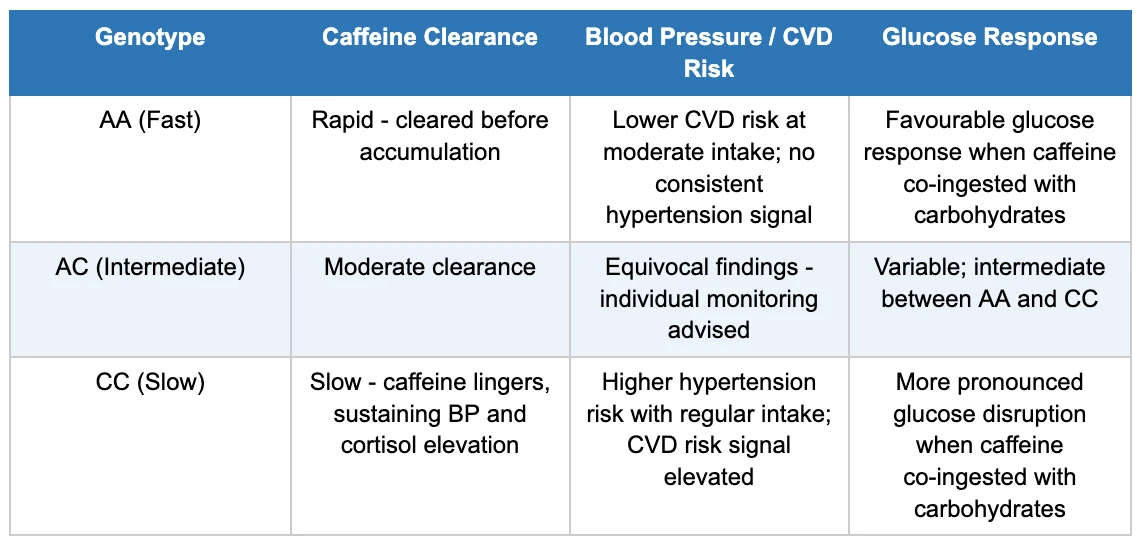
A systematic review of seventeen studies investigating genetic variation in caffeine metabolism and cardiometabolic outcomes found that CYP1A2 rs762551 moderates the association between coffee intake and hypertension - with slow metabolisers (CC genotype) showing a greater rise in blood pressure with habitual caffeine intake compared to fast metabolisers. The same review found that ADORA2A rs5751876 moderated caffeine's association with blood pressure, and that CYP1A2 genotype modified the glucose response when caffeine was co-ingested with carbohydrates (Virgili et al., 2023).
The mechanism is straightforward: in slow metabolisers, caffeine remains in circulation long enough to sustain elevated sympathetic nervous system activity - raising blood pressure, keeping cortisol elevated, and potentially contributing to arterial stiffness with chronic exposure. Fast metabolisers clear caffeine before these effects accumulate at clinically relevant levels. This rapid breakdown of caffeine might unmask the beneficial effects of other compounds in coffee, such as chlorogenic acid and caffeic acid, both of which are antioxidants that may protect the heart.
Switching from unfiltered espresso or French press coffee (which contain lipid-raising diterpenes) to filtered coffee reduces an additional layer of cardiovascular risk, regardless of genotype.
The table below summarises what each genotype means across performance and health domains:
The table below summarises how genotype modifies the cardiometabolic effects of habitual caffeine intake:
FAQs
Why does caffeine work brilliantly for some people and seem to do nothing - or make things worse - for others?
Your CYP1A2 genotype is the dominant reason. Fast metabolisers (AA) clear caffeine quickly enough to capture its ergogenic window without accumulating levels that trigger counter-productive stress responses. Slow metabolisers (CC) retain caffeine well past its useful window. ADORA2A receptor sensitivity further shapes whether caffeine manifests as focus and drive or anxiety and discomfort, independent of how fast you clear it.
How much caffeine should I take before exercise, and does my genotype change the answer?
The ISSN Position Stand identifies 3–6 mg/kg body weight as the dose range with consistent ergogenic evidence, with minimal effective doses potentially as low as 2 mg/kg. For fast metabolisers, supplementing within this dose range 30–60 minutes before exercise is well-supported for endurance and strength. For intermediate metabolisers, starting at 3 mg/kg and assessing individual response is advisable. For slow metabolisers, the evidence for endurance performance is against high doses - caffeine impaired rather than improved performance in trials. If caffeine is used for resistance training, keeping to the lower end of the range (3 mg/kg) limits the risk of prolonged exposure and associated side effects.
Does caffeine help build muscle or just improve performance in the gym?
Both, potentially. Beyond acute performance effects, there is emerging evidence that caffeine supplementation may enhance adaptations to resistance training, including gains in strength and power over time, possibly through increased training volume and reduced perceived effort during sessions. The acute benefit for strength (1RM, velocity, power) is well-supported, particularly for fast metabolisers who show the most consistent peak power improvements in anaerobic performance trials.
If I am a slow caffeine metaboliser, should I avoid it entirely before training?
Not necessarily but the picture is genotype- and context-dependent. For endurance and sprint-type training, the evidence is clear that high doses are likely to be counterproductive for slow metabolisers, with one trial showing a 13.7% performance worsening at 4 mg/kg. For resistance training, where the broader strength literature shows effects somewhat independent of genotype, slow metabolisers may still derive some benefit, particularly for 1RM and muscular endurance, though peak power improvements are less consistent. Keeping to the lower end of the recommended dosage range and avoiding caffeine close to sleep is the most prudent approach.
Is caffeine risky for my heart if I drink coffee regularly?
Genotype matters here. For fast metabolisers, habitual coffee consumption at moderate levels (2-4 drinks) does not appear to raise hypertension risk meaningfully. For slow metabolisers, regular caffeine intake is associated with elevated blood pressure and a greater cardiovascular disease risk signal. Switching to lower caffeine drinks such as black tea, or herbal teas are a good option for slow metabolisers.
What role does ADORA2A play compared to CYP1A2?
CYP1A2 governs how long caffeine stays in your system - primarily determining its performance effects. ADORA2A governs receptor sensitivity - primarily determining psychological side effects such as anxiety, jitteriness, and sleep disruption, as well as moderating cardiovascular and glucose responses. You can be a fast CYP1A2 metaboliser and still experience significant ADORA2A-driven anxiety if your receptor sensitivity is high. The two variants are independent, which is why testing both provides a more complete and actionable picture of your individual caffeine response.
Does caffeine affect men and women differently based on genotype?
The CYP1A2 genotype-dependent performance effects appear largely consistent across sexes, with review evidence suggesting caffeine is ergogenic for resistance exercise performance in females to a similar magnitude as in males (Grgic, 2021). One important practical consideration: oral contraceptive use can significantly inhibit CYP1A2 enzyme activity, making women on hormonal contraception effectively slower metabolisers of caffeine, independent of their underlying genotype. This is worth factoring into dosing decisions.
Can I change how fast I metabolise caffeine through diet or lifestyle?
Your genotype is fixed, but CYP1A2 enzyme activity is mildly modifiable. Cruciferous vegetables (broccoli, Brussels sprouts) can modestly upregulate activity; smoking significantly increases it. Conversely, certain medications - including oral contraceptives, some antibiotics, and proton pump inhibitors - can inhibit the enzyme. These effects are modest relative to the underlying genetic difference between AA and CC individuals. The most effective strategy is calibrating caffeine dose, timing, and frequency to your genotype rather than attempting to shift your metabolic rate.
Know your genotype. Train smarter, not just harder.
Your CYP1A2 and ADORA2A genotypes are among the most immediately actionable results in your FitnessGenes DNA report. Whether you are optimising endurance performance, getting more from your strength training, or protecting long-term cardiovascular health, understanding how your body handles caffeine turns guesswork into a personalised, evidence-based strategy.
Citations
Guest NS, VanDusseldorp TA, Nelson MT, et al. International society of sports nutrition position stand: caffeine and exercise performance. J Int Soc Sports Nutr. 2021;18(1):1. DOI: 10.1186/s12970-020-00383-4
Guest N, Corey P, Vescovi J, El-Sohemy A. Caffeine, CYP1A2 Genotype, and Endurance Performance in Athletes. Med Sci Sports Exerc. 2018;50(8):1570–1578. DOI: 10.1249/MSS.0000000000001596
Southward K, Rutherfurd-Markwick K, Badenhorst C, Ali A. The Role of Genetics in Moderating the Inter-Individual Differences in the Ergogenicity of Caffeine. Nutrients. 2018;10(10):1352. DOI: 10.3390/nu10101352
Wang J, Dewi L, Peng Y, et al. Does ergogenic effect of caffeine supplementation depend on CYP1A2 genotypes? A systematic review with meta-analysis. J Sport Health Sci. 2024;13(4):499–508. DOI: 10.1016/j.jshs.2023.12.005
Virgili J, Motitis P, Julal G, Mavrommatis Y, Pilic L. The impact of genetic variability on the relationship between caffeine and cardiometabolic outcomes: A systematic review. Nutr Bull. 2023;48(1):28–42. DOI: 10.1111/nbu.12606
Grgic J. Effects of Caffeine on Resistance Exercise: A Review of Recent Research. Sports Med. 2021;51(11):2281–2298. DOI: 10.1007/s40279-021-01521-x
Minaei S, Rahimi MR, Mohammadi H, et al. CYP1A2 Genotype Polymorphism Influences the Effect of Caffeine on Anaerobic Performance in Trained Males. Int J Sport Nutr Exerc Metab. 2022;32(1):16–21. DOI: 10.1123/ijsnem.2021-0090