
Hereditary haemochromatosis is a genetic condition that causes iron overload: the gradual build-up of excess iron in the body. Normally, your body tightly controls how much iron it absorbs from food. With haemochromatosis, that control breaks down, so you absorb more than you need, day after day, for years. Because there's no natural way to shed the surplus, it accumulates in organs like the liver, heart, and pancreas - which is why catching it early matters.
A raised iron or ferritin reading on a blood panel isn't always a diet problem - sometimes it's down to your DNA.
What causes haemochromatosis?
Hereditary haemochromatosis is caused by variants in the HFE gene, which normally helps regulate how much iron your intestines absorb from food. When this gene doesn't function properly, your body loses its ability to switch off iron absorption once you have enough, so levels keep climbing regardless of how balanced your diet is.
It's an inherited condition, which means it runs in families and is present from birth, even though symptoms typically don't appear until adulthood - often not until iron has been quietly accumulating for decades.
After my mother was diagnosed with haemochromatosis later in life, I wanted to know early if I also had the condition, and how I could manage it. With long wait times for a DNA test through the NHS, I used FitnessGenes. The process was simple, fast, and the reporting was clear. I discovered I carried just one copy of the risk variant, which was reassuring. Highly recommend to anyone who wants to know their HFE status, I will most certainly test my new daughter the same way. - Charlie Aprahamian
What is the genetic link? C282Y and H63D explained
Two variants in the HFE gene account for the vast majority of hereditary haemochromatosis cases: C282Y and H63D.
C282Y is the variant most strongly linked to significant iron overload. Haemochromatosis is typically inherited in an autosomal recessive pattern, meaning you generally need to inherit a copy of the variant from both parents to be at high risk of developing clinically significant overload. People who inherit just one copy are usually carriers - they may show mildly elevated iron markers but rarely progress to serious organ damage.
H63D is a milder variant. On its own, it's associated with a much lower risk of iron overload. It becomes more relevant when it's inherited alongside one copy of C282Y, a combination that can still raise iron levels, though usually less severely than two copies of C282Y.
Carrying one of these variants doesn't guarantee you'll develop symptoms - penetrance varies considerably, and lifestyle factors like alcohol intake, dietary iron, and other genetic influences all play a role in whether iron overload actually progresses to organ damage.
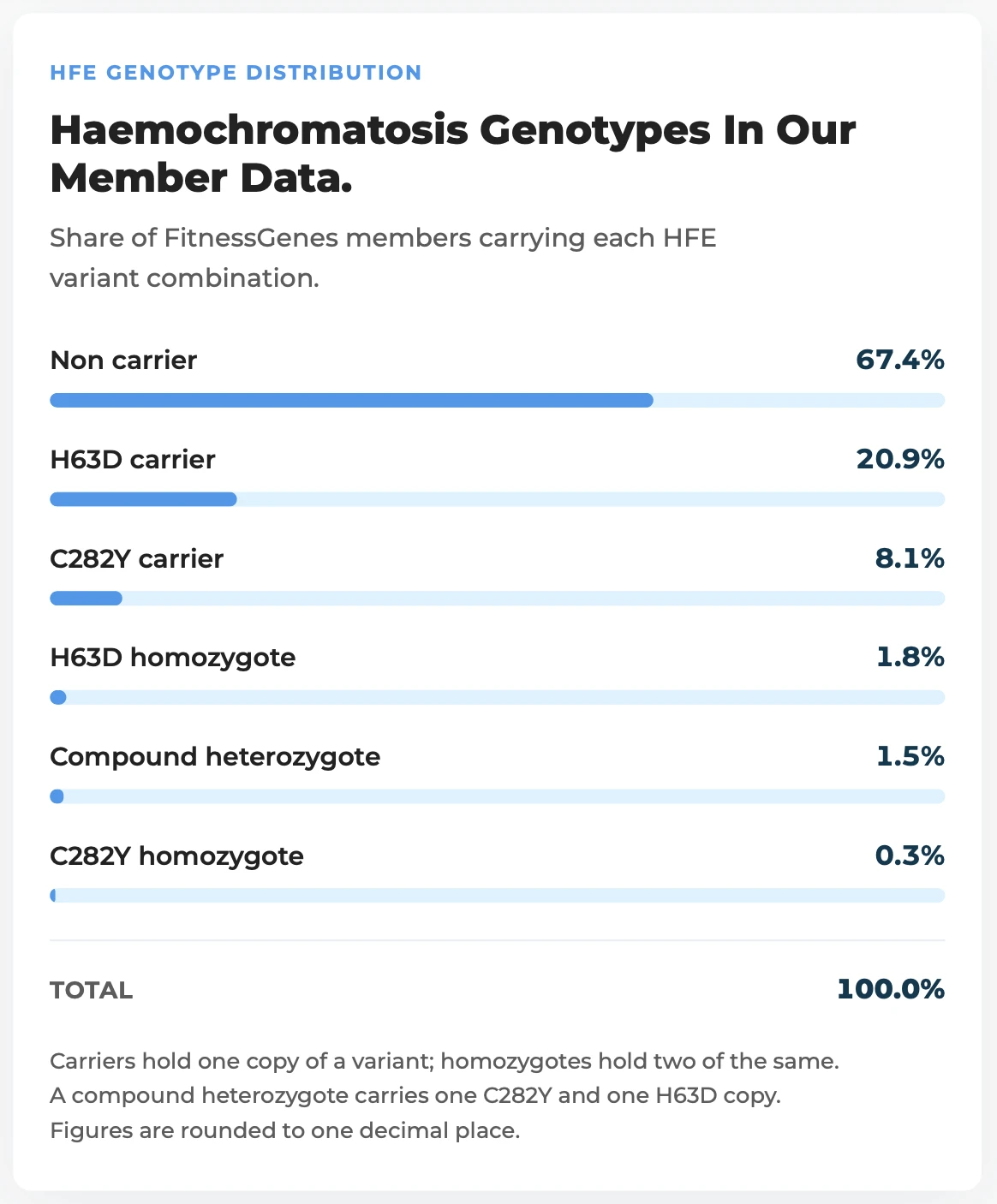
To put those genotypes in perspective, here's how they break down across our own FitnessGenes member data:
Why is haemochromatosis known as the "Celtic curse"?
Hereditary haemochromatosis is sometimes nicknamed the "Celtic curse" because it's especially common in people of Celtic, Irish, Scottish, and other Northern European descent. Across Northern European populations as a whole, HFE-related haemochromatosis is considered the most common single-gene genetic disorder, with C282Y homozygosity (two copies of the variant) affecting around 1 in 200 people.
The concentration is starker again closer to home. Three years of cross-community screening by Haemochromatosis UK found that 1 in 10 people in parts of Northern Ireland are at risk of iron overload. Anywhere those communities settled in numbers, a comparable frequency travelled with them - the difference abroad is that almost no one is looking for it. If your ancestry traces back to Ireland, Scotland, Wales, or other Celtic and Northern European populations, it's worth considering finding out your genetic result. Testing can provide reassurance or point you toward the right next steps.
Why is getting your iron levels assessed vital?
Because haemochromatosis develops silently. Early symptoms - fatigue, joint pain, low mood, reduced libido - are vague and easy to attribute to stress, ageing, or overtraining. By the time more obvious signs appear, such as liver dysfunction, diabetes, or heart problems, iron may have already been accumulating in organ tissue for years.
Regular blood testing for markers like ferritin and transferrin saturation is the most reliable way to catch rising iron levels before they cause damage. If you carry a genetic predisposition, testing isn't a one-off - it's something to monitor over time, because ferritin can climb gradually and cross into problematic territory without any noticeable change in how you feel.
If you already invest in regular blood panels, knowing your HFE status adds essential context: it tells you whether a raised ferritin result is likely to be a passing blip or the start of a pattern worth tracking closely.
How does diet affect your iron levels?
Diet doesn't cause haemochromatosis, but it does influence how quickly iron accumulates in someone who's genetically predisposed - and it matters just as much for people who need to raise low iron levels.
Some foods enhance iron absorption, some reduce it, and others are simply high in iron to begin with - which matters whether you're trying to lower your levels or raise them.
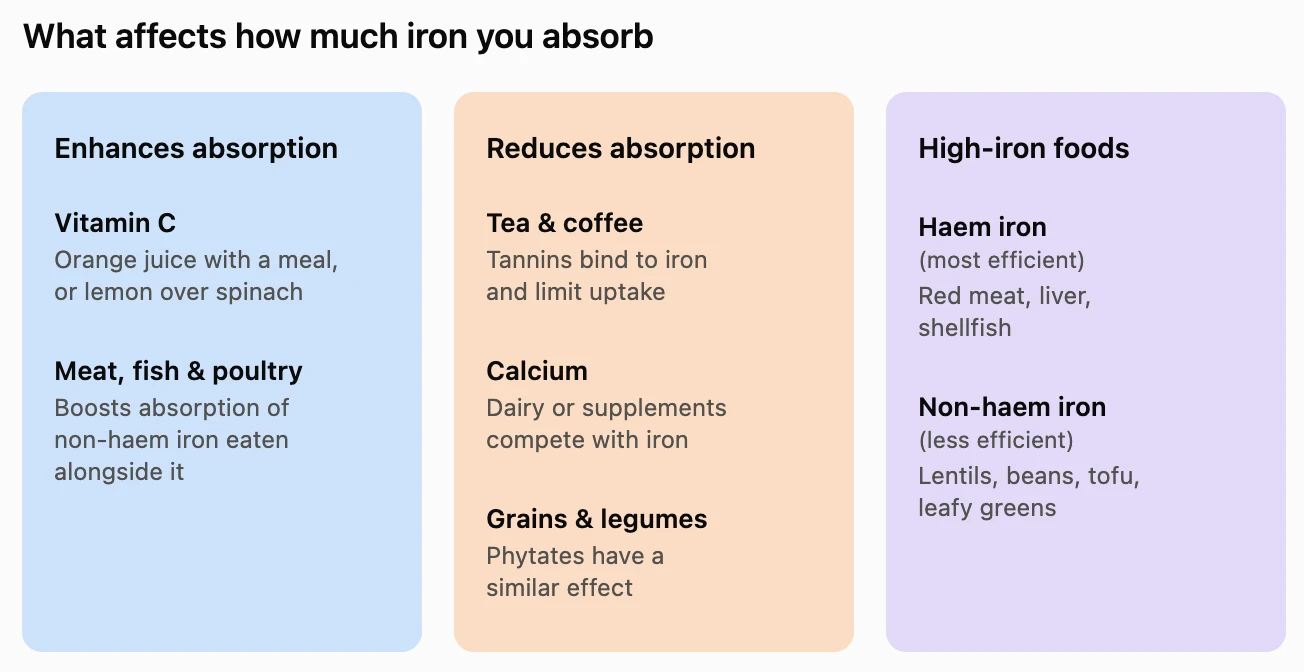
For someone managing haemochromatosis, pairing meals with tea or coffee rather than vitamin C, moderating red meat and organ meat intake, and avoiding iron and vitamin C supplements are simple, practical levers. For someone with low iron, the reverse applies - pairing iron-rich foods with vitamin C and separating them from tea, coffee, or calcium can make a meaningful difference.
Why women are less likely to show signs than men
Menstruation offers women a degree of natural protection against iron accumulation, because regular blood loss provides an ongoing route for excess iron to leave the body. This is why women with haemochromatosis often don't show signs of overload until after menopause, when that monthly outlet disappears and iron can begin building up more steadily.
This delay has a real downside: it means women carrying high-risk HFE variants can be significantly underdiagnosed or diagnosed later than men, sometimes only once iron levels have already climbed substantially. Pregnancy and heavy blood loss during childbirth can offer similar temporary protection. It's a good reason for women with a family history of haemochromatosis not to assume normal-range ferritin in their 30s or 40s rules out a genetic predisposition worth knowing about.
FAQs
Can a DNA test diagnose haemochromatosis?
No. A DNA test can identify whether you carry high-risk HFE variants like C282Y or H63D, but diagnosis requires clinical blood tests - typically ferritin and transferrin saturation - interpreted by a healthcare professional, sometimes alongside a liver biopsy or MRI in more advanced cases.
If I carry one copy of C282Y, will I definitely develop iron overload?
Not necessarily. Carrying a single copy generally makes you a carrier rather than someone at high risk of clinically significant overload. Two copies of C282Y, or one copy of C282Y alongside one of H63D, carry a higher risk, though even then, not everyone who carries these variants goes on to develop symptomatic disease.
At what age do symptoms of haemochromatosis usually appear?
Symptoms most commonly appear between the ages of 30 and 60, though this varies significantly. Men tend to present earlier than women, largely because menstrual blood loss delays iron accumulation in women until after menopause.
What are the early warning signs of iron overload?
Early signs are often nonspecific and easy to dismiss: persistent fatigue, joint pain (particularly in the hands), low mood, and reduced libido. This vagueness is exactly why relying on symptoms alone often leads to late diagnosis.
Should I avoid iron supplements if I have a genetic predisposition to haemochromatosis?
Generally, yes. If you carry high-risk HFE variants or have confirmed iron overload, iron supplements and high-dose vitamin C supplements (which boost iron absorption) are typically discouraged. Always discuss supplementation with a healthcare professional first.
Is haemochromatosis treatable?
Yes. The standard treatment is therapeutic phlebotomy - regularly removing blood to lower iron levels, similar to donating blood. Caught early, before organ damage occurs, outcomes are generally very good.
Can diet alone manage haemochromatosis?
No. Dietary adjustments - limiting red meat, avoiding iron and vitamin C supplements, drinking tea or coffee with meals - can help slow accumulation, but they don't replace medical monitoring and treatment such as phlebotomy where indicated.
Does everyone with haemochromatosis need the same level of monitoring?
No. Monitoring frequency depends on your specific genotype, current ferritin levels, and other risk factors like alcohol intake. This is exactly where knowing your HFE status through DNA testing helps you and your doctor decide how closely to track things over time.
References
Adams, P., Altes, A., Brissot, P., Butzeck, B., Cabantchik, I., Cançado, R., Distante, S., Evans, P., Evans, R., Ganz, T., Girelli, D., Hultcrantz, R., McLaren, G., Marris, B., Milman, N., Nemeth, E., Nielsen, P., Pineau, B., Piperno, A., Porto, G., Prince, D., Ryan, J., Sanchez, M., Santos, P., Swinkels, D., Teixeira, E., Toska, K., Vanclooster, A. and White, D. (2018) 'Therapeutic recommendations in HFE hemochromatosis for p.Cys282Tyr (C282Y/C282Y) homozygous genotype', Hepatology International, 12(2), pp. 83-86.
Adams, P.C. and Ryan, J.D. (2025) 'Diagnosis and Treatment of Hemochromatosis', Clinical Gastroenterology and Hepatology, 23(9), pp. 1477-1485. Available at: https://doi.org/10.1016/j.cgh.2024.10.041
Crownover, B.K. and Covey, C.J. (2013) 'Hereditary hemochromatosis', American Family Physician, 87(3), pp. 183-190.
Fuchs, J., Podda, M., Packer, L. and Kaufmann, R. (2002) 'Morbidity risk in HFE associated hereditary hemochromatosis C282Y heterozygotes', Toxicology, 180(2), pp. 169-181. Available at: https://doi.org/10.1016/S0300-483X(02)00389-X
Gleeson, F., Ryan, E., Barrett, S. and Crowe, J. (2004) 'Clinical expression of haemochromatosis in Irish C282Y homozygotes identified through family screening', European Journal of Gastroenterology & Hepatology, 16(9), pp. 859-863. Available at: https://doi.org/10.1097/00042737-200409000-00008
Haemochromatosis UK. Three-year cross-community screening programme, Northern Ireland.
Milman, N.T. (2020) 'A Review of Nutrients and Compounds, Which Promote or Inhibit Intestinal Iron Absorption: Making a Platform for Dietary Measures That Can Reduce Iron Uptake in Patients with Genetic Haemochromatosis', Journal of Nutrition and Metabolism, 2020, 7373498.