A genetic fitness test analyses variants in your DNA linked to how your body responds to exercise, recovery, and nutrition. It's done with a one-time saliva sample and gives you detailed, personal insight into your fitness potential and risk areas - from muscle building capacity to injury risk.
If you already track macros, structure your training in blocks, and treat your body like a system to be optimised, genetic testing is the next data source most people haven't tapped yet.
Where does this fit with your Whoop or Garmin data?
Your wearable is very good at telling you your current state. It is less useful for telling you why, or what you should do next. You can watch HRV sit flat for three weeks, resting heart rate refuse to come down, or a VO2 max estimate stay frozen across two training blocks, with nothing to tell you whether that’s a programming problem, a recovery problem, or simply where your physiology sits.
That’s the gap genetic data fills. It gives you the baseline your metrics should be read against, and the trainability context that decides whether a plateau is worth fighting or worth working around.
- A metric that won’t move may already be close to your ceiling. If your results point to lower VO2 max trainability, another eight weeks of the same stimulus is unlikely to be the answer. Changing your approach is.
- A number that looks bad may just be your baseline. Some people naturally sit higher for resting heart rate. Knowing that stops you chasing a target that was never realistic, and stops you reading a normal reading as a warning sign.
- A low recovery score isn’t always a training problem. Variants tied to greater exercise-induced muscle damage mean harder sessions cost you more in inflammation and repair time - so more recovery time is required rather than training harder.
Used together, your wearable tells you where you are week to week, and your genetics tells you which of those numbers is actually worth focusing on.
How does a genetic fitness test actually work?
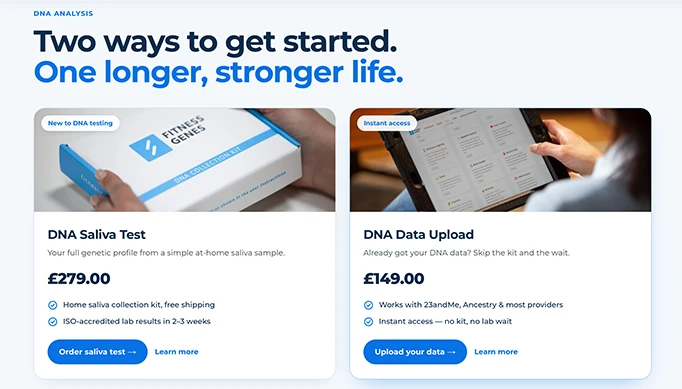
It starts and ends with a single sample. If you've never tested before, a non-invasive saliva collection kit arrives within about five days. You register the sample online, post it back, and results are typically ready in two to four weeks. If you've already tested with a provider like Ancestry or 23andMe, you can upload that existing raw data instead and see your results straightaway - no second sample needed.
That's also the last time you'll ever need to test. Your DNA doesn't change, so one sample is enough for life. What does change is the interpretation: as new peer-reviewed research is published, providers like FitnessGenes revisit their reports and update your recommendations accordingly, comparing the latest science against the DNA data you already provided. You end up with a result that gets more useful over time.
What does FitnessGenes actually look at, and why does it matter for training?
For serious trainers, a few of the reports that are important for building fitness and recovering are:
- Muscle recovery after exercise – highlights genes linked to slower recovery, and therefore would alter the way you structure workout plans during the week.
- Resting heart rate & heart rate variability – gives you an indication of where you naturally sit and how your autonomic nervous system will cope with training load.
- Lactate threshold – the intensity at which lactate starts to accumulate faster than your body can clear it, a key ceiling for sustainable race-pace or tempo work.
- VO2 max trainability – not just your current aerobic capacity, but how much headroom your genetics suggest you have to improve it with the right training stimulus.
Genetics explains a meaningful share of the variation between two people doing the same programme and getting different results. The HERITAGE Family Study, one of the most cited datasets in exercise genomics, found substantial familial clustering in how much VO2 max improves in response to standardised training - some people are simply higher or lower "responders" for reasons rooted in their DNA (Bouchard et al., 1999; Bouchard et al., 2011). Genome-wide studies have identified dozens of loci associated with resting heart rate and cardiac rhythm, reinforcing that even a metric as simple as RHR has real genetic architecture behind it (den Hoed et al., 2013). None of this replaces measured training data - it explains more of the why behind the numbers you're tracking.
Ready to see what your own DNA says?
Get your FitnessGenes DNA test. One saliva sample. Results across 15 health and fitness categories, built to show you exactly where your genetic ceiling and floor sit for muscle building, endurance, recover, and more.
Can a DNA test really build you a personalised training plan?
This is where genetic testing earns its place over generic programming. A DNA test on its own is just data - the value comes from combining it with your training history, goals, and lifestyle to produce a plan built around your physiology rather than an average person's. FitnessGenes does this through its proprietary TrueTrait™ model, which layers your genetic results with the inputs you provide to generate protocols that are specific: adjusted caffeine timing, prioritised eccentric loading for injury-prone joints, a minimum protein threshold per meal, tailored cardio-to-strength balance based on your trainability profile.
This isn't theoretical. Alex, part of the FitnessGenes team and a competitive triathlete, found through his own results that he's a fast caffeine metaboliser and carries a genetic marker for reduced nitric oxide production (NOS3) - insight that led him to time caffeine intake before races and add beetroot shots to his diet for blood flow. A separate marker flagged an elevated risk of exercise-induced muscle damage, which shaped how he now structures recovery and nutrition around training blocks. None of that came from a generic plan; you can read more about his experience here.
You get more with BASIL
Your DNA results are the foundation. BASIL turns them into something you act on, week to week.
BASIL is the FitnessGenes personalised health engine. It takes your genetic results, combines them with your lifestyle answers and any health data you add (blood work, wearable metrics, body composition) and builds a live picture of where your biology is working for you and where it’s working against you. Two things separate it from a static report.
It provides a starting point. BASIL scores every impact area behind the goal you have chosen and ranks them, biggest problem first. Working on longevity, that means seeing how you sit across cellular ageing, inflammaging, metabolic ageing, vascular ageing, brain ageing, musculoskeletal fitness, systemic ageing, and toxins and infections – each score traced back to the specific trait results driving it. You aren’t guessing which lever matters most, because the ranking is built from your own data.
It gives you ranked actions, not a catalogue. For each area, BASIL highlights the supplements, foods, and habits most likely to benefit 4you, sorted by an evidence-weighted effectiveness rating and carrying an evidence grade, so you can see how strong the science behind each action is before you commit. Mark what you’re already doing, hide what you don't want, and the list re-ranks around what’s achievable for you.
BASIL regularly updates too. Every data point you add (a new blood panel, an updated questionnaire answer, a change in training) feeds back into the scores and recommendations. And the same goal-based approach runs across muscle building, endurance, fat loss, energy, blood sugar, bone strength, gut health, hormone health, brain health, and cardiovascular health, so you can push performance and long-term health at the same time instead of choosing between them.
Explore BASIL.
FAQs
Is a genetic fitness test the same as an ancestry DNA test?
No. Ancestry tests focus on lineage and ethnicity. A genetic fitness test analyses variants linked to exercise response, recovery, inflammation, and hormone function to generate training and nutrition recommendations, not family history.
Do I need to retest as my training or goals change?
No. Your underlying DNA doesn't change, so one sample covers you for life. What updates is the interpretation - as research evolves, your reports and recommendations are refreshed without needing a new sample.
How accurate are the results?
FitnessGenes processes samples through an ISO 17025 and ISO 9001 accredited lab, one of Europe's largest high-throughput genomics facilities, and only releases results once at least 95% of genetic variants have been reliably identified across multiple quality control checkpoints.
Will the test tell me about disease risk?
FitnessGenes specialises in health and fitness genetics rather than disease diagnosis. The genomic panel does include some disease-related genes, but you choose whether to receive that information.
I already tested with 23andMe or Ancestry - do I need to test again?
No. You can upload your existing raw data and access your FitnessGenes results immediately, without providing a new saliva sample.
Can this help if my progress has plateaued?
Yes - this is one of the most common reasons serious trainers test. Genetic insights can surface factors you haven't considered, such as inflammation response, recovery capacity, or caffeine metabolism, that explain why a programme working for someone else isn't working the same way for you.
Who's behind the science?
FitnessGenes' in-house research team is led by Dr. Stuart Grice, Co-founder and Chief Scientific Officer, who completed his PhD in Neuroscience at the University of Oxford. The company holds a granted patent (EP-3488369-A1) for its method of integrating genetic and lifestyle data into personalised wellness protocols, and has collaborated with institutions including the University of Oxford and Loughborough University.
References
Bouchard C, An P, Rice T, et al. (1999). Familial aggregation of VO2max response to exercise training: results from the HERITAGE Family Study. Journal of Applied Physiology, 87(3), 1003–1008.
Bouchard C, Sarzynski MA, Rice TK, et al. (2011). Genomic predictors of the maximal O2 uptake response to standardized exercise training programs. Journal of Applied Physiology, 110(5), 1160–1170.
den Hoed M, Eijgelsheim M, Esko T, et al. (2013). Identification of heart rate-associated loci and their effects on cardiac conduction and rhythm disorders. Nature Genetics, 45(6), 621–631.
Rankinen T, Pérusse L, Rauramaa R, Rivera MA, Wolfarth B, Bouchard C. (2006). The human gene map for performance and health-related fitness phenotypes. Medicine & Science in Sports & Exercise, 38(11), 1863–1888.